As new engineers arrive, they pull up chairs in his office.
Paul Fonua asks the questions first. Where are you from? What team are you on? What interests you?
Then he explains what the department does and why it matters.
He wants to hear their stories before sharing his.
Some years, 50 or 60 newly hired engineers and scientists join his department through the Engineer and Scientist Development Program. That’s more names than he can remember. Every one of them knows his.
Some do the math on 35 years out loud.
“They’re like, ‘Wow, you’re older than my dad,’” Fonua said.
He's 58. His energy says 50.
“I’m no Mario Lopez,” he said. “That guy still looks 16.”
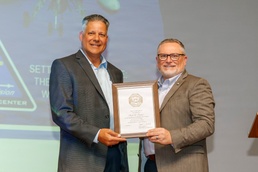
On Monday, Aug. 24, at Point Mugu, Fonua received his 35-year Length-of-Service Award.
“It’s amazing to actually get here,” Fonua said. “After five or 10 years, you’re like, ‘Wow, those guys are super old.’ When you reach 20 or 25 years, those guys are still super old. And now, at 35-plus, it’s like, ‘Wow.’”
He leads the Weapons and Warfare Systems Test Department at Naval Air Warfare Center Weapons Division. He became deputy director in June 2022 and director in March 2025.
Across 12 assignments, one habit hasn’t changed.
He gets to know you first.
Raised on Oahu, Maui and the Big Island, Fonua uses one Hawaiian word to describe how he sees people.
“It’s ohana. That’s family,” Fonua said. “I see everyone as family.”
After Fonua graduated from Embry-Riddle Aeronautical University in 1990, his mother kept calling from Hawaii.
A job was waiting in the tourist industry. “Come home,” she told him.
He didn’t go.
In 1991, Fonua found himself pulling cable through attic spaces for some of Point Mugu’s first computer networks. An aeronautical engineering degree but no engineering job. A family friend in base security learned that engineering interviews were happening and passed along Fonua’s name.
Gill Acuña, a branch head, called and insisted Fonua come in during his lunch break.
Fonua arrived in jeans and a T-shirt, dust in his hair. The front office mistook him for a janitor. Acuña didn’t.
“All the respect he gave me, unearned, will always leave an impression on me,” Fonua said.
Then the work started.
An early test plan came back covered in red ink from three levels of review. He learned the technical answers were not the hard part.
“Physics doesn’t change,” Fonua said. “Things will do what things do. The reason this stuff is hard is often a lot of communication and a lack of trust.”
Within a few years, Fonua led his first test team.
A wing from an early Joint Standoff Weapon test hangs on his office wall. A contractor named Chuck gave it to him. The AGM-154 was the first weapon to align its GPS with the aircraft before launch. Its range allowed an aircrew to strike from beyond the defenses around a target.
Fonua was 27 and based at Point Mugu, but he ran the developmental test program from China Lake. The flight-test team included Dave Saulque Pete Byers and Fonua.
A developmental test program today might launch only three or four weapons, he said. His team launched 54 in 18 months. Fonua later helped operational testers move the AGM-154 toward the fleet.
“It’s kind of like your first love,” Fonua said. “You never forget it.”
He offers simple advice to new engineers.
“Stay technical as long as you can because it matters,” he said.
Fonua managed to stay technical for 13 years. Then in 2004, he became head of the Strike Warfare Branch, his first supervisory assignment.
That job came as the wars in Afghanistan and Iraq continued.
The Standoff Land Attack Missile-Expanded Response, or SLAM-ER, had already been used in both conflicts. The missile could strike a target from long range while an aircrew watched its final approach through a video link and refined the aimpoint.
“SLAM-ER was humming,” Fonua said. He noted that his branch was doing extensive training and supporting those operations.
Becoming a branch head also changed his perspective on the job.
“I thought those guys could solve world peace,” Fonua said. “Then it dawned on me. I’m just a cog on a wheel in a room full of wheels and cogs. I don’t know if I can change much for my people.”
He used a broken chair as an example. Replacing one requires money, a contract and several levels of approval.
But what he could still reach was the person across the desk.
People come through his open door when they are stuck. Sometimes it’s a facility problem, and he can make a few calls. But usually it’s more than that.
“Everybody needs and wants help,” Fonua said. “They all have barriers.”
Fonua had received that kind of help himself. Tom Curtis, a former department director, gave him opportunities he didn’t recognize as mentorship until years later: the Combined Federal Campaign, command strategic planning and the Federal Executive Institute.
“I didn’t know he was mentoring me when he was mentoring me,” Fonua said. “But he gave me a whole bunch of opportunities.”
Then you have some lead test engineers who keep everything in their own heads.
“What if you get hit by a truck? We’re in trouble,” Fonua said. “We got nobody else. Don’t let your legacy be the downfall of this organization.”
People are one-half of what Fonua calls a dual bottom line. The mission’s the other half.
Take a weapon meant for an F/A-18. His engineers wire it into the jet, check that it fits and ensure their digital systems are communicating properly. Then they take it up and shoot it.
“Does it hit or does it miss?” Fonua said. “And what’s good enough?”
At Gray Flag, the large-force test event held at Point Mugu each fall, Navy developmental testers and most operational testers for F/A-18s and F-35s come from his department. Fleet operators attend to see what might reach them in a year or two.
The event tests how those systems work together in the same battlespace. Because when the fleet needs them, they have to work the first time.
Many of the people counting on that work never walk through NAWCWD's gates. Some employees can spend their entire careers at NAWCWD without ever speaking to anyone in uniform, Fonua said.
His journey took him through the U.S. Naval Test Pilot School and onto the U.S. Third Fleet staff. His office was aboard the command ship USS Coronado (AGF 11). He spent 17 months working with the people who use what NAWCWD tests.
“I’ve known warfighters,” Fonua said. “I want them all to come back home. And that’s why it matters.”
He made a clear distinction between his service and theirs.
“I can surely give a career to this mission,” Fonua said. “I’m not offering my life. And I’m well aware of the difference between the two.”
And then there’s something Fonua loves to do: the phone call.
When selections for the U.S. Naval Test Pilot School are final, Fonua gets to tell people they were chosen. Since 2022, he estimates he has told 10 to 12 of them. Fonua received that call in 1997 and spent a year at Patuxent River, Maryland.
“It’s probably the most enjoyable thing I’ve ever done,” Fonua said. “The smile, the happiness they have. It’s something I got to feel when I was told I was going to go.”
Sometimes they get the news by phone. Sometimes he delivers it in person. Early on, he told one or two a year. Now he tells three a year.
Awards, school selections and the goodbye when someone retires. Each one’s a chance, as he put it, to “kind of love on them.”
“Just the thank-you matters,” he said.
New engineers and scientists in the program have arrived in recent weeks. Fonua hasn’t met them yet.
He’ll begin where he always does. Where are you from? What team are you on? What interests you?
After that, he’ll explain the work and let them know what to call him.
“I want them to say, ‘Hi, Paul,’” Fonua said. “None of this Mr. Fonua stuff.”