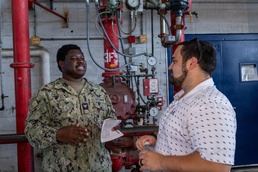
Inside an aircraft hangar, Logistics Specialist 2nd Class Jeremiah Loyd met Naval Supply Systems Command Weapon Systems Support (NAVSUP WSS) supervisor Wayne Cain. One worked where aircraft parts become operational requirements; the other supported the broader supply network behind them. As they compared experiences face-to-face, the distance between their workplaces gave way to a shared mission.
Their conversation during NAVSUP WSS’s “Meet the Fleet” initiative connected the Sailor and civilian sides of naval logistics, showing how communication across the supply chain supports aircraft safety, Fleet readiness and the warfighter.
Loyd supervises, manages and tracks supplies and aircraft parts supporting personnel and mission readiness for Strike Fighter Squadron 106. He said the squadron's mission is to train pilots for Fleet readiness across naval aviation.
" ‘Can't Fly without Supply’," Loyd said.
Intellectually, Cain had always understood the effect NAVSUP WSS employees have on warfighting readiness from their workspaces, but meeting Loyd and seeing the aircraft, parts and maintenance operation added a human and operational perspective.
"Going and seeing the parts and support that we provide in action is the ultimate reminder," Cain said.
Loyd already knew civilians played an important role in the Navy supply system. His conversation with Cain, however, helped reveal more of the work performed beyond the operational unit.
"Each occasion I get to interact with our civilian counterparts I am enlightened a little bit more on the extensive work that goes into making sure the fleet is successful," Loyd said.
As Cain and Loyd discussed their work, they found that Sailors and civilians encounter some of the same frustrations with systems and procedures. Cain said their discussion focused on improving processes, solving problems and preventing obstacles from recurring instead of assigning blame.
"It is refreshing connecting with those who we communicate with from a distance," Loyd said. "It shows we are all working toward the same mission despite the differences."
For Cain, the exchange reinforced that every level of the supply enterprise wants to improve. He credited Fleet personnel for the lengths they take to keep aircraft flying and ships sailing despite the constraints they face.
The hangar also gave their conversation a physical backdrop. Cain watched maintainers work meticulously to preserve aircraft safety. His five years of experience as a planner had shown him how time limits on parts can complicate planning, but hearing maintainers explain how small problems can grow into failures gave those requirements new meaning.
"It makes you thankful that we spent so much time and effort to inspect and ensure safety, even though it might make the planning aspect a little harder," Cain said.
Loyd explained where his role fits when maintenance identifies a requirement.
"My role is to identify, order and track parts required for maintenance," he said. Civilian employees help source and move those parts through supply systems while supporting the systems and information the Fleet needs to operate.
The conversation gave each participant a view of the other's responsibilities that routine communication may not provide. Loyd learned more about the details of civilian positions, while Cain saw how civilian work affects personnel at the operational level.
That shared understanding supports Department of the Navy lines of effort focused on taking care of its people, defending the homeland through peace through strength and supercharging the industrial base. It also provides operational context for the NAVSUP WSS campaign plan to shift the Navy's supply chain from a just-in-time model to a just-in-case strategy and eliminate backlogs in repair parts.
Cain said he would take the full scope of the operation back to his team: Sailors and civilians working through different parts of the same system toward the same goal. He expressed hope that more NAVSUP WSS employees will receive the opportunity to meet the people their work supports.
For Loyd, meeting Cain reinforced how work at the unit level connects to the Navy's larger supply and logistics network. His message to the civilian workforce closed the distance between the two sides of that network: "I would want them to understand that their work doesn't go unnoticed and that it has a direct impact on Sailors and fleet readiness."
Naval Supply Systems Command Weapon Systems Support (NAVSUP WSS) provides the U.S. Navy, Marine Corps and allied forces with program and supply support for the weapon systems that keep naval forces mission ready. With locations in Philadelphia; Mechanicsburg, Pennsylvania; Norfolk, Virginia; and Tucson, Arizona, NAVSUP WSS manages operational readiness for almost 300 deployable ships, 92 submarines and 3,700 aircraft worldwide.