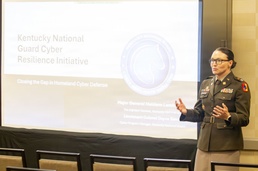
LOUISVILLE, Ky. — U.S. Army Lt. Col. Dayna Sanders spoke to local leaders at the 2026 Governor’s Local Issues Conference, Aug. 20.
As the cyber program manager for the Kentucky National Guard, she addressed the digital threats facing the commonwealth and encouraged stakeholders to engage in meaningful partnerships to ensure resilience.
“The battlefield is not specific to kinetic attacks,” Sanders said. “Now we have this invisible layer to battlefields.”
Sanders emphasized the importance of cyber resilience, pointing to its relevance with recent attacks exploiting vulnerabilities found in critical infrastructure.
“We’re under an active digital occupation,” Sanders said. “When people think about war, we think about kinetic attacks — like things blowing up or bullets flying. We don’t think about the digital things. It’s not when they get in — they’re already in. We need to understand that and share that message.”
Sanders spoke about the modern cyber threat of quiet occupation in networks and infrastructure. With persistence over time, these incursions can cause chaos and disruption, ultimately degrading trust between communities and the government.
“The things that they care about most—supply chains, water treatment plants, power, electrical grids, transportation systems,” she said. “By living in those infrastructures, they’re holding our communities hostage. It’s just when they want to take advantage of it.”
While cyber threats are not a new problem, significant gaps exist in homeland cyber defense.
Federal agencies are often limited by authorities when it comes to directly assisting after an incident. Federal agencies lack the resources to defend a large volume of local utilities and operate on broader strategic priorities, leaving municipal infrastructure vulnerable.
On the other hand, states and their governors are responsible for safeguarding their citizens and infrastructure. However, when states cannot outsource support during an incident, or when federal aid is delayed, the risk is high.
According to Sanders, that’s where the National Guard comes in.
With its dual federal and state mission, the National Guard plays a unique role in homeland defense. However, Sanders said it’s not just a military problem – it’s a whole-of-government and industry challenge that requires a shared understanding and unified effort across state, local, and private sectors.
Sanders also encouraged attendees to break information silos through proactive collaboration, thoughtful legislation, and sharing capabilities with the goal of identifying threats and reducing risk before an incident.
“We want to break down those silos, we want to connect you with the resources we have,” said Sanders. “The goal is to decrease risk and increase resilience. The initial step is making an effort to understand what the needs are.”
The Kentucky National Guard Cyber Resilience Initiative (KY CRI) builds trust and shared cyber capabilities across public and private sectors. Through domestic operations and community outreach, the initiative exchanges knowledge and information with partner organizations.
The KY CRI provides generalized and specialized training, recommends ways to harden networks, and offers on-site assistance during cyber incidents.
“We want to get to know each other before an incident occurs,” said Sanders. “We want to help you identify the vulnerabilities in your networks and physical installations so that when something does happen, you know exactly who to turn to.”
The KY CRI also hosts an annual cyber exercise called Cyber Bluegrass. The exercise leverages partners and resources across public and private entities to establish a framework for cyber-related disaster preparedness and response. This year, Cyber Bluegrass is slated for Oct. 27–29 in cooperation with Murray State University, the University of Louisville, the Defense Advanced Research Projects Agency, and the Kentucky Office of Homeland Security.
By forging partnerships across the cyber enterprise, the Kentucky National Guard builds capacity for modern homeland defense and ensures Kentucky’s communities remain secure, resilient, and ready to face future threats.