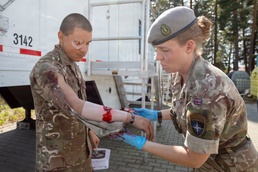
Bemowo Piskie, POLAND —The training began with U.S. and British soldiers portraying casualties and calling for help after being injured. Moulage depicting wounds covered their faces, arms, legs, and chests.
The role players from 2nd Battalion, 37th Armored Regiment (2-37 AR) portrayed casualties for U.S. Soldiers who completed a week of Combat Lifesaver (CLS) training.
The CLS qualified Soldiers were tasked with moving the wounded to a triage area and evacuating them to the Role 1 medical facility. At Role 1, multinational doctors and medics from the NATO Forward Land Forces Battle Group-Poland provided additional treatment on Aug. 26, 2026, at the Bemowo Piskie Training Area, Poland.
“I definitely thought it was good training, being able to go out there and actually see injuries,” said U.S. Army Pfc. Aiden Johnson, assigned to the 2-37 AR. “It was also a good exercise because we were able to carry the casualties.”
CLS students practiced applying their recently completed training in a realistic mass-casualty scenario. They practiced treating casualties, conducting initial assessments, and responding under pressure.
The exercise provided valuable hands-on experience and reinforced the skills they had learned in the week of class.
U.S. Army Pfc. Noah Hugen, assigned to the 2nd Battalion, 37th Armored Regiment, described treating one of the simulated casualties.
“He was ambulatory, so we walked him over to Role 1 and handed him off to the medics for them to continue their treatment,” Hugen said.
After the casualties arrived at the Role 1 medical facility, the soldiers portraying the wounded were transferred from litters to treatment tables on either the U.S. or British side of the medical tent.
Romanian soldiers from the 348th Air Defense Artillery Battalion also assisted with transporting and treating casualties alongside U.S. Army Capt. Ryan Thomas, a field surgeon assigned to the 2nd Battalion, 37th Armored Regiment.
While treating a casualty with a simulated eye injury, Thomas instructed the medics to keep his head elevated above his heart to help control blood flow.
“I think we both added to each other’s training,” Thomas said. “It’s nice for them to get some practice, and it’s good for us to get some practice as well.”
While the Romanian medical team worked in the U.S. treatment area, British medical personnel treated simulated casualties on the opposite side of the tent.
U.S. Army combat medic Sgt. Emily Lower, assigned to the 2nd Battalion, 7th Armored Regiment, worked alongside a British general duties medical officer.
“Their equipment’s a little bit different, but not so different that I couldn’t adapt to it quickly,” Lower said. “It was really cool working with her, and she’s super smart and knows what she’s doing.”
The U.S. medics gained experience working with allied medical providers, particularly a British army doctor and medic. They became familiar with differences in terminology, procedures, and medical equipment while learning to adapt quickly and continue patient care.
The training also allowed the medics to refresh their skills at the Role 1 medical facility and gain experience managing casualties similar to those they had seen during Combined Resolve in Germany months prior.
The mass-casualty exercise gave U.S. medics and Combat Lifesaver students practical experience working alongside British and Romanian personnel in a multinational medical environment.
This event highlighted participants’ ability to communicate, use unfamiliar equipment, and provide coordinated care across different nations and levels of medical training.