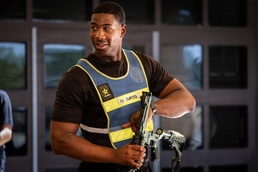
Operation Wildcat Rising puts key elements of a future Reserve training model through an actual BCT cycle ahead of a larger effort planned for fiscal year 2027.
FORT SILL, Okla. – This summer, 1st Brigade, 95th Training Division, put a wartime training concept into practice at Fort Sill, testing whether an Army Reserve drill sergeant formation could help expand Basic Combat Training capacity during a major conflict while maintaining the same standard for new Soldiers.
During Operation Wildcat Rising, 1st Brigade partnered with the 434th Field Artillery Brigade to test the concept during an actual BCT cycle. Maj. Gen. Michael J. Dougherty, commanding general of the 80th Training Command, joined Col. Matthew A. Horning, commander of 1st Brigade, and Col. Anthony Brunner, commander of the 434th Field Artillery Brigade, at Fort Sill Aug. 15 to assess the pilot and review what it had revealed.
The effort centered on Echo Battery. In previous years, Reserve drill sergeants supporting similar missions were often distributed across active component organizations to fill individual requirements. For Wildcat Rising, the 95th staffed Echo with Reserve leaders and drill sergeants who remained together through the mission. Active component cadre from 1st Battalion, 31st Field Artillery, provided mentorship and assessment.
The scale was significant enough to test the concept under real conditions. Ninety-one Reserve Soldiers participated in the mission, including 65 drill sergeants. By the end of the cycle, 133 trainees had graduated from BCT. The 434th's after-action review identified that outcome as the central measure against which the pilot had to be judged.
Horning said this year's effort was deliberately limited in scope. The battalion-level pilot was designed to reduce risk and identify requirements before a larger brigade-level effort planned for fiscal year 2027. Questions included how to manage transitions between Reserve teams, what training and certifications Soldiers needed before arrival, and how manpower would be organized to sustain the mission.
“Our drill sergeants told us this experience was worth several traditional rotations,” Horning said. “Now we take what we learned, give our formations the preparation time they need and refine the model for the next phase.”
The larger question reaches beyond Fort Sill. In a major war, the Army could be required to generate trained Soldiers at a pace that places new demands on its existing training base. Army planners are examining whether Reserve formations could provide some of that additional capacity by arriving prepared to help lead BCT organizations rather than simply supplying individual Soldiers to fill gaps.
Bruner said that requirement helped shape the partnership between the two brigades. Wildcat Rising allowed them to work through parts of the problem during a live training cycle, before an urgent wartime need forced the Army to solve them at scale.
That approach also meant the pilot could not be judged only by what 1st Brigade learned. Soldiers moving through Basic Combat Training still had to receive the training the Army expects, regardless of which component delivered it.
“At the end of the day, we have to train these men and women for combat,” Dougherty said. “Basic Combat Training is step one, and we have to get that right. There is one standard, and we have to train to that standard.”
The after-action review found that Wildcat Rising also exposed practical obstacles to scaling the approach. Some Reserve cadre arrived at Fort Sill still needing required certifications, while communication gaps left some unclear about requirements before the mission began. The three-week rotation model also compressed transitions between outgoing and incoming teams, leaving limited time to transfer knowledge about the procedures governing daily BCT operations.
Those findings gave the two commands concrete areas to address rather than abstract lessons from a planning exercise. The review called for stronger pre-arrival coordination and certification, protected overlap between rotating teams and more deliberate continuity between iterations.
The next phase is intended to build on that foundation rather than treat one BCT cycle as final validation. The after-action review found broad support for keeping Reserve Soldiers together as units and recommended a phased approach in which shorter missions help identify capable teams before longer training and certification periods. The 95th and 434th also plan to formalize lessons from the partnership for future missions.
Staff Sgt. Scarlett Rose Mitchell brought 15 years of Army experience to Wildcat Rising, including similar missions in which Reserve drill sergeants filled individual requirements within active component formations. This time, she remained with the Reserve team executing the mission.
“In 15 years in the Army, I’ve never felt my experience was put to better use than it was on this pilot program,” Mitchell said. “I’ve never felt more valued.”
Wildcat Rising did not attempt to answer every question about how the Army would expand its training base in war. It moved a piece of that problem from planning into an actual BCT cycle, produced 133 new Soldiers and gave Army leaders a clearer understanding of what Reserve formations will need before the concept is attempted at greater scale.
That is the pilot's larger value. If a major conflict forces the Army to train more Soldiers quickly, the work of figuring out how Reserve formations can help expand the training base will not begin on the first day of the crisis.