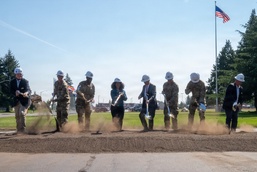
JOINT BASE LEWIS-McCHORD, Wash. – Joint Base Lewis-McChord held a groundbreaking ceremony August 25 at the I Corps Joint Operations Center, Lewis Main, to kick off a secretary of the Army-directed initiative that will include 19 projects on base to modernize infrastructure, housing and energy resilience supporting I Corps and the 62nd Airlift Wing.
“Today is a very exciting day because we are going to show the entire country and the entire world that Joint Base Lewis-McChord is, yet again, a trendsetter and a pacesetter,” said Marilyn Strickland, congresswoman for Washington’s 10th district and a self-proclaimed “proud military brat.” “By having this project FORGE here, we are going to demonstrate ... that we can build, that we can rebuild, and we can renovate and do so in a timely manner that uses the scarce resources that we have the most efficient way.”
Army Materiel Command is implementing the pilot project, called FORGE (Facilities, Operations, Readiness, Growth and Experience). It is designed to modernize legacy military construction and repair projects by adopting commercial best-practices, design-build-to-budget models, and flexible contracting. These methods are meant to save time and money, ultimately providing updated facilities to service members faster and increasing their overall readiness.
Lieutenant General Matthew McFarlane, commanding general of I Corps and Joint Base Lewis-McChord, said he believes FORGE “means readiness.”
“America’s I Corps and Joint Base are breaking the mold on how the Army builds, modernizes, and accelerates our readiness for what our nation’s asking us to do through efforts like FORGE,” McFarlane said. “The pace of competition in the Pacific demands that we adapt at the speed and scale of need, to deliver the infrastructure and resources our service members need to train, deploy and win. That’s why FORGE matters.”
The FORGE process is faster because it combines two tools: Other Transaction Authorities — highly flexible legal agreements that bypass Federal Acquisition Regulation restrictions to bring in non-traditional partners and slash acquisition timelines — and enterprise Architect-Engineer contracts, which are single agreements that contract professional firms to handle projects from start to finish. The OTA and A-E combination has demonstrated time savings of up to 50% and cost savings of up to 30% over legacy methods. Meanwhile, the government continues its traditional oversight and approval roles.
The Army awarded a $169.1 million Other Transaction Authority to Conti Federal Services LLC for the JBLM pilot, which will include a five-year performance period lasting through July 2031. During that time, the following are included on the modernization list: operational facilities, housing, and airlift deployment to support Indo-Pacific force projection.
“The FORGE pilot represents a new approach — one built around collaboration, innovation, flexibility, and speed, moving beyond traditional approaches to a model focused on outcomes and mission requirements,” said Peter Ceribelli, CEO of Conti Federal Services LLC. “That takes vision, that takes courage, that takes leadership. And most importantly, it takes trust. The government has challenged industry to think differently. Conti is proud to accept that challenge.”
The impact of JBLM’s FORGE won’t end in 2031. The pilot remains AMC’s lead demonstration of bundling projects to quicken delivery and apply new authorities and industry technology, showing how the Army can move forward at other installations.
The Honorable W. Jordan Gillis, assistant secretary of the Army for Installations, Energy, and Environment, said installations are “even more important now than they’ve ever been to the expeditionary Army.”
“Installations aren’t just the places where we keep our equipment, or where we live in the barracks, but this is where we train to deploy and fight and win our nation’s wars and, increasingly, these are the places from which we fight,” Gillis explained.
Lieutenant General Gavin Lawrence, deputy commanding general and acting commander of U.S. Army Materiel Command, said JBLM’s FORGE project “is just the beginning.”
“It provides a model where the Army can refine, scale, and apply wherever urgent infrastructure is needed, and the lessons that we learn from this project will shape how we modernize our installations, will shape how we can accelerate delivery, shape how we can improve cost and performance, and also provide facilities where our (service members) and families get what they deserve as they serve our nation,” Lawrence said, adding he believes FORGE will “make an enduring difference” for those training at JBLM and those who rely on the base “as a power-projection platform for the Pacific and beyond.”