FORT RUCKER, Ala.—The home of Army Aviation held its Portfolio Acquisition Executive-Maneuver Air Industry Days event at Fort Rucker, Ala., August 25-26.
With the theme of “Delivering Capability Today,” the event included guest speaker and panel sessions, as well as booth space for more than 40 aviation industry vendors to display their wares and Army aircraft static displays.
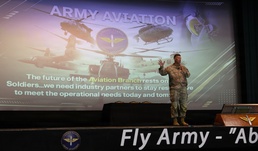
The Aviation Center of Excellence and Fort Rucker commanding general, Maj. Gen. Clair A. Gill, who has also served as the Portfolio Acquisition Executive-Maneuver Air, provided an Army aviation branch update.
“Welcome to the home of Army aviation, and welcome to Industry Days,” Gill said. “It’s great to see so many friendly faces. I hope that today and tomorrow are a great opportunity for us to have some dialogue.”
“We had a really good plenary session over at the Seneff (building) yesterday. One comment that I took as we were talking to our Future Capabilities Directorate was, ‘how do we understand what your requirements are?’ I think that’s something that we’re going to try to share with you as the Army is evolving its requirements, concepts, and experimentation enterprise,” Gill said.
Gill noted the world is quickly changing.
“We are watching warfare evolve at just a record pace, and we know that we have to remain on the front edge of transformation. We can’t wait for something to happen and then decide maybe we should transform with it,” Gill said.
“That is going to require all of us, industry and the Army to be moving in concert with each other. We have to keep those conversations going,” he said. “You have to tell us what you’re developing, we have to tell you what we need, and we have to marry those things up.”
Gill said Army aviation must be ready to deploy, fight and win.
“We operate in the context of the ground domain. I think of us as ground Soldiers who happen to have the skill and capability to break friction with the ground,” Gill said.
He said the Army is in a “tough spot” financially due to the continuing resolution: “We did not come out of this year with fully funded programs,” Gill said. “We talk about the schedule, (and want to move) fast, but cost still matters to us.”
Across multiple efforts, Army aviation is trying to generate good outcomes at a reasonable price, he noted.
The proponent for Unmanned Aircraft Systems rests within aviation PAE-Maneuver Air portfolio, working in concert with other teammates including the Maneuver Center of Excellence, which is developing doctrine for Groups 1 and 2 UAS.
With Army aviation exploring the “unmanned space” more, Gill explained that unmanned technology has matured to include stabilization and autonomy.
The Army moved away from the Shadow UAS in favor of pursuing commercial off the shelf technology, but backed away from those capabilities because leaders believed they were not quite where they wanted them to be, he said. He expects to have funding in 2027 to put tactical UAS capability back in Aviation brigades.
“The call to industry there is, keep pace with us as we are moving in the direction of more autonomy, more unmanned capability,” he said.
The Army has quickly trained more than 190 Tactical Unmanned Aircraft System specialists; the 15X Military Occupational Specialty is “the trainer, fabricator, operator, advisor for all things UAS for battalion and brigade teams,” Gill said.
The Unmanned Advanced Lethality Course at Fort Rucker, developed in conjunction with the Army’s Combat Capabilities Development Command and the Maneuver Center of Excellence, addresses a gap for the Army by training tactical Group 1 and 2 UAS operators.
“Planning, executing, survivability training—it’s a very tactical course. We’re very proud of it,” he said. By Fiscal Year 2027 he anticipates the number of UALC graduates to be approximately 300.
Gill said the MV-75 aircraft, which will be known as the “Cheyenne II,” represents a great partnership with industry toward a “capability that will change how we fight.” He added, “We have to make sure we execute this program with discipline.” The protype is expected by the end of FY27.
Virtual prototypes are currently being used to help ensure that when the capability comes off the production line, the concepts have been “proofed out” across the DOTMLPF-P and Soldiers are ready to receive and train with the new tiltrotor aircraft.
During a session, Rodney Davis, Capability Program Executive for Aviation, highlighted the changing character of war, emphasizing that UAS enhances manned aviation rather than replacing it. Army aviation is moving toward a continuous feedback loop and away from testing as a “final exam” for compliance. This includes having operational events where prototype technologies get into the hands of Soldier operators and maintainers long before production decisions are made.
The event featured a session focused on Joint UAS and The Marketplace – a centralized, mission-ready website that provides a Soldier focus, free market approach and trusted storefront (https://uasmarketplace.army.mil/); and a session on The Anatomy of a Win: Delivering Capability Today from the perspective of the Global Tactical Edge Acquisition Directorate.
Aviation subject matter expert panel sessions provided program updates including for attack platforms, cargo, fixed-wing, utility, Future Long Range Assault Aircraft and more.