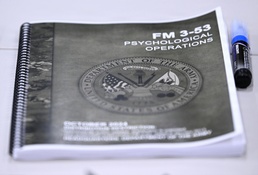
FORT BRAGG, N.C. — Eight Army National Guard information operations officers graduated from a newly developed Psychological Operations Qualification Course, July 24, at the U.S. Army John F. Kennedy Special Warfare Center and School, marking a significant milestone in Army transformation. For the first time, Soldiers from all three components; Regular Army, National Guard and Army Reserve, are training together to combat modern cognitive warfare threats.
As adversaries increasingly rely on sophisticated disinformation campaigns and information warfare to undermine global stability, the Army recognized a need for a unified response. The new, integrated training model ensures that Army psychological operations and information operations professionals across the total Army share the same baseline skills and strategic understanding required to counter these evolving non-kinetic threats on the battlefield.
"The Army National Guard's information warfare transformation is fundamentally prompted by the need to stay ahead of our adversaries' ever-changing threats through continuous innovation," said Brig. Gen. Isaac Martinez, assistant director of the Army National Guard for aviation, intelligence and information. Martinez explained that the constant threat of adversarial action drives changes to information operations in creating a need for Guard officers who can conduct rapid, strategic analysis and act accordingly.
"Graduation from the 10-week pilot program at the U.S. Army John F. Kennedy Special Warfare Center and School is part of the National Guard's modernization effort in information warfare by introducing psychological operations officers to the Army National Guard landscape to conduct information warfare overseas," said Maj. Shaun Neil, information warfare branch chief for the National Guard Bureau.
Despite conducting information operations for over 20 years in support of conventional and special operations, this effort will close the Guard’s gap between planning and execution.
"Historically, military information operations have suffered from technological operational delays," Martinez said. "Strategic planners would design operational packages and then wait on specialized execution groups to implement them."
In the swiftly shifting space of digital information, these delays often rendered tactical responses obsolete before they could even be fully deployed.
"The course aims to prepare cross-functional leaders who can address planning and execution simultaneously, supporting faster decision-making on the battlefield," said Col. Kirsten Roy, commander of the Expeditionary Military Intelligence Brigade and Information Forces Modernization lead for the National Guard Bureau.
Roy emphasized this approach is fundamental in an environment where fast decision-making can determine mission success or failure, where building on the goal of developing leaders capable of managing planning and execution in real time is essential.
"Speed is critical to mission execution," Roy said during a recent roundtable discussion about the Guard's broader modernization efforts. "The newly structured training has undergone two iterations and empowers officers to consolidate a wide array of previously disjointed capabilities, including intelligence gathering, data analysis, cyber warfare and electromagnetic warfare, and integrate them with psychological operations units. These newly minted officers are comprehensively equipped to implement the changes required to operate at the speed that modern, digital-first threats demand."