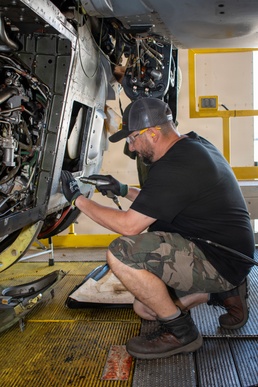
MARINE CORPS AIR STATION CHERRY POINT, N.C. -- A small team of aircraft maintenance professionals at the Fleet Readiness Center East (FRCE) detachment on board Marine Corps Air Station New River is making a tangible difference on flightline readiness for the V-22 squadrons stationed there.
Since 2014, the FRCE V-22 line at New River has posted a perfect on-time delivery record of the aircraft the team overhauls, returning them to the Marine tiltrotor squadrons who need safe, mission-ready aircraft to support national defense objectives. In fact, of the more than 75 aircraft delivered to the fleet during that time frame, more than 97% have arrived ahead of schedule, some with turnaround times almost 30% under projections.
The benefits of providing consistent, dependable service while driving down maintenance turnaround times are easy to explain, said Lavon Vance, head of FRCE’s New River V-22 Branch: “More aircraft, faster: It’s all about giving them back to the fleet.”
While the explanation may sound simple, the work done at New River has a critical, real-world effect said FRCE Commanding Officer Capt. Randy J. Berti.
“The operational impact of the V-22 line at FRC East’s New River detachment cannot be overstated,” Berti said. “These dedicated aircraft maintenance professionals directly enhance flight line readiness by giving our Marines the reliable, mission-ready aircraft they need when they need them. I couldn’t be more proud of this team and the world-class work they do every day in support of the warfighter.”
The results are also, quite literally, easy to see. Right outside the spaces FRCE shares with the Marines, the squadrons’ operational V-22 aircraft sit ready on the flight line – clearly visible from the hangar decks where FRCE artisans overhaul them during planned maintenance interval (PMI) events.
“At New River, we have the only FRC East PMI line where you can walk out on the flight line and see your planes, and with the number of PMIs we complete each year, we’ve touched every one of them,” Vance said. “We get to look out of our hangar every day, and we see the cost of our business – it's the Marines on the flight line who are flying the planes that we work.”
The team’s proven track record means the Marines can depend on FRCE to return the aircraft when it’s due, Vance noted.
“Plainly put, when you walk into a maintenance control officer's space and you ask what the most important thing to his maintenance schedule is, I have only ever heard consistency: Give me the aircraft when you said you would,” Vance said. “And for FRC East, for 10-plus years, we induct when we need to induct and it goes back out the door when it needs to go back out the door.”
The unique relationship the New River detachment has with the operational units it services plays a huge part in being able to meet these mission-critical timelines, Vance said.
“While the V-22 PMI specification is the V-22 PMI specification no matter where you’re at, comparing the New River work to other PMI lines is not apples to apples,” he explained. “In comparison to the V-22 line at FRC East Cherry Point or at other depots, the work is the same but much of the preparation and follow-up are very different.”
At FRCE New River, the V-22 aircraft are inducted for maintenance when they are towed in from the squadron after the Marines do a good deal of the prep work, and they are towed back to the squadrons for final buildup and completion. This differs vastly from FRCE Cherry Point, for example, where the aircraft typically fly in and out.
The New River Detachment also doesn’t have what’s called “over and above,” or O&A discrepancies, where needed maintenance that is not part of the PMI process is discovered during inspections and overhaul. These discrepancies are resolved by the custodial squadron and contract employees during the PMI event or scheduled as an in-service repair request, or ISR.
“If unexpected issues are encountered, that can become an ISR,” Vance said. “In that case, we complete the PMI, and then the Marines come and get their aircraft, tow it back to their squadron, continue with the buildup and coordinate with our ISR planners to send a team over to complete that maintenance requirement outside of the PMI process. We don’t have that extra workload to complete while the aircraft goes through PMI, so we’re able to maintain our timeline.
“When the aircraft has to fly out after the PMI, any O&A discrepancies must be corrected first,” he continued. “Not having to address those during the PMI is to our advantage and is a significant difference that most people miss when they try to compare us to other V-22 lines.”
Another advantage the New River team has, in terms of driving down turnaround times, is the condition in which they receive the aircraft, many of which come in from a training squadron. That means the aircraft have not experienced the same harsh conditions as aircraft used in an operational environment.
“The majority of the time, those aircraft come in better material condition than your average fleet aircraft because they don't deploy,” Vance said. “They stay here at New River, and they're used solely for training.” Being co-located with the squadrons they service also aids the FRCE team by allowing maintainers to see the condition of the aircraft before it’s ever inducted.
“The process starts before we even get the aircraft,” Vance explained. “Once we have an aircraft on the schedule, we can go out and observe while the Marines are breaking the aircraft down so we can get an idea of its condition, let them know if we need them to clean an area better so we can get a better look at it, things like that.
“At the same time, we’re able to see any non-PMI issues that may be present and coordinate with the Marines before we take custody of the aircraft,” he continued. “We can let them know in advance if there’s a problem, and we can start talking to engineering to come up with a solution for it now that we implement in an ISR once the maintenance evolution is complete. We don’t have to wait until we have the aircraft in hand before we figure out what we do with it.”
The team’s solid performance even allowed the New River V-22 line to take on an additional aircraft PMI this year when supply constraints impacted turnaround times, including at FRCE’s headquarters on Cherry Point. Once those logistical issues were solved, an all-hands effort to complete maintenance evolutions launched across the enterprise. For FRCE, having the New River team available to assist made a huge difference in the ability to return an additional combat-ready aircraft to the fleet.
“They really stepped up; the New River workforce buckled down and worked extremely hard to shorten the duration of their scheduled PMIs and open a window in their normal workflow to fit in an extra aircraft,” said Allen Williamson, V-22 Branch head at FRCE Cherry Point. “We gave them an aggressive but achievable goal, and their workforce came together to reach that goal for FRC East as a whole.
“Their performance really highlights FRC East’s team unity,” Williamson continued. “We have sites in three different locations throughout the continent – Cherry Point, New River and Destin, Florida – and we can come together and function as a team. We’re doing what we need to do and developing creative solutions to meet the warfighter’s needs, regardless of one particular site's goals or challenges.”
Being able to provide service the Marines can depend on is a point of pride for the team at New River, Vance said. “We’re local. These are our friends and family flying those aircraft. It means something to us to deliver that product back to them,” he said. “We’ve always prided ourselves at New River in giving the plane back to you when we told you we were going to, and that’s a hard sell in any aircraft maintenance environment because you have all of these unforeseens – but we are, in a good way, boringly predictable.
“That’s where we succeed,” Vance added. “We found a process. We’re able to rinse and repeat that process on every aircraft. We took a few years to figure it out, but now ... it’s not broke, so don’t fix it. And we keep rolling.”
FRCE is North Carolina's largest maintenance, repair,overhauland technical services provider, withmore than 3,600civilian,militaryand contract workers. Its annual revenue exceeds $886 million. The depot provides service to the fleet while functioning as an integral part of the greater U.S. Navy; Naval Air Systems Command; and Commander, Fleet Readiness Centers.