‘Daddy, What’s D-Day?’:
Young curiosity brings 100th ARW historian full circle to Square D past, present
By Airman 1st Class Iris Carpenter
100th Air Refueling Wing Public Affairs
Editor’s note: This is the second of a two-part article on Robert Paley, 100th Air Refueling Wing historian, telling how after rejoining the Army after 9/11, his journey brought him to RAF Mildenhall with the 100th ARW and 100th Bomb Group. Read Part One of this story here (link).
RAF MILDENHALL, England: In 1989, Robert Paley, 100th Air Refueling Wing historian, fulfilled his childhood dream of rendering his first salute, after graduating from the U.S. Military Academy at West Point, to his father, and presenting him with a very special silver dollar.
His father died in 1991. Afterward, Paley said, the family searched for the silver dollar and could not find it.
Paley had joked that his father might have used it to buy a candy bar at the hospital canteen though his family rejected that possibility because they believed he understood what the coin represented. He said he would still like to know where it went, but the coin had already served its purpose.
“That silver dollar was destined to be my dad’s, 11 years after I made the promise,” Paley said.
Fulfilling one promise did not make the rest of Paley’s path simple. He served as an Army field artillery officer after graduating from West Point in 1989. In 1993, during a reduction in force, Paley accepted an opportunity to leave active duty.
The decision separated him from the military for eight years.
9/11 reinforces decision to rejoin the fight
“I was miserable for those eight years trying to make it in the corporate world,” Paley said.
On Sept. 11, 2001, Paley was living in Columbus, Ohio, and working in the mortgage business. He said he was standing in his bedroom, putting on a purple tie and preparing for work, when his then-wife, Lisa, called from the airport in Detroit.
She told him an aircraft had just struck the World Trade Center and asked him to turn on the television. He saw smoke pouring from the building while they continued speaking on the phone.
Then the second aircraft struck.
Lisa asked him what the attack meant.
“This means we’re at war,” he told her. “Don’t get on your next flight to Chicago!”
Paley said the second impact made his next step clear.
“It was simple,” he said. “As soon as the second one hit the tower I knew I was going back in the military.”
Tie off, uniform back on
He pulled off his tie and called the National Guard immediately, Paley said. After already having spent months trying to return to military service, officials had been unable to locate enough of his paperwork to verify his previous commission.
Paley recalled that when he called the recruiter, he was told they were busy and to call back the next day. After doing so, he said the recruiter answered with a response he did not expect.
“The National Guard had located enough documentation to verify my previous commission, and I only needed to pass a physical,” he said.
On Dec. 27, 2001, Paley appeared before a three-person federal recognition board. He said the officers questioned him about his fitness to return after an eight-year break in service. They eventually called him back into the room and told him they would allow him to recommission as a lieutenant.
My country needs me
As Paley repeated the oath, the same words he had spoken when he first became an officer carried a different weight. This time, the country was at war.
“I became choked up during the oath, and the board members’ attitudes changed when they realized what returning meant to me,” he said.
The first time Paley entered the Army, it was to honor his father. This time, however, he returned because he felt his country needed him.
Years later, he said he received another phone call that gave him an opportunity to connect the child fascinated by military history and the officer who repeatedly chose service.
Paley retired from the Army in 2019. A few months later, he and his British wife, Alison, were visiting her parents in England when she happened to be looking for jobs for Rob online and found an opening for a historian at RAF Mildenhall.
“She told me the position closed the following day, so I stayed awake until approximately 2 a.m. building a resumé. I didn’t expect to be selected because I’d never served in the Air Force or worked as a professional historian.”
About 30 days later, Paley received an invitation to interview. He said he prepared at his home office in Ohio, surrounded by military books and photographs collected over years of studying history.
Square D destiny
While he prepared for the interview, a print that hung on his office wall caught his attention. It showed a B-17 with a Square “D” marking on its tail, which was the marking of the 100th Bomb Group.
The print had been hanging on his wall for approximately six years.
“At that point, I felt it was destiny,” Paley said.
During the interview, he was asked what he knew about the Bloody Hundredth. He began talking about the 100th Bomb Group, expanded into the Eighth Air Force and continued through the combined bomber offensive. By the time he stopped, the interview panel told him he had taught them information they didn’t know.
Weeks passed, and Paley said he began to believe someone else had received the position.
He was sitting in his car in his Ohio hometown when a phone number beginning with the United Kingdom’s country code appeared on his screen. He answered, assuming the call would be a rejection.
Paley recalled how Col. Cassius Bentley, then-100th ARW vice wing commander, told him that while he had not been the most experienced candidate, the wing was willing to take a chance on him.
Bentley asked whether Paley could bring the same enthusiasm from the interview to the Airmen he would teach about RAF Mildenhall and the Bloody Hundredth. Paley promised he could.
He and Alison arrived in England in January 2020, and he said he’s been trying to live up to that promise ever since.
Karen Abeyasekere, a 100th Air Refueling Wing Public Affairs specialist, said she met Paley around the time he arrived at RAF Mildenhall. Although their work did not bring them close immediately, that changed in June 2021 while working on the Rosie’s Riveters nose art dedication together, which honored Lt. Col Robert “Rosie” Rosenthal, renowned 100th BG pilot who flew 52 missions during his time at Thorpe Abbotts during World War II.
Abeyasekere said she and Paley soon became “solid friends,” describing him as knowledgeable, genuine, animated and emotional.
Bringing history from the head to the heart
“His passion for the 100th Bomb Group becomes visible as soon as he begins speaking about it,” said Abeyasekere. “Rob doesn’t simply repeat dates or list facts. He becomes animated, uses humor and makes the people inside the history feel close enough to know.”
Abeyasekere said that connection with Paley became even more real in 2023 when he had the chance to drive John “Lucky” Luckadoo, 100th Bomb Group and 351st Bomb Squadron pilot who was stationed at Thorpe Abbotts during World War II, back to his home base 80 years to the day that he flew his most harrowing mission over Bremen.
This was the third time both Paley and Abeyasekere had met the legendary pilot, the other two times being at 100th BG reunions in the States.
Abeyasekere said Paley later described driving Luckadoo in Paley’s car on the way to the 100th BG Memorial Museum, sitting beside a man whose missions he had studied, moved history from the books and photographs into the passenger seat. Paley said the experience gave him chills.
The meeting represented the part of history that Paley said matters most: the people who carried it.
At Thorpe Abbotts museum, where the 100th Bomb Group flew combat missions during World War II, Paley also discovered a community committed to protecting those memories.
He said he contacted the museum shortly after beginning work at RAF Mildenhall. Approximately 20 volunteers arrived to meet him during the work week. Many had personal or familial connections to the former airfield, he said.
“Once I met the people running it, it went from the head to the heart,” Paley said.
Thorpe Abbotts diorama, from dilemma to delight
That connection also took physical shape through the Thorpe Abbotts diorama which was lovingly built by the historian.
“Rob spent nearly two years building the detailed model. When the completed display wouldn’t fit into his car, he used what appeared to be a bread knife to cut it in half so he could transport it. It then fit into his and Alison’s cars perfectly. Once transported to the museum and placed in its display cabinet, with all the finishing touches such as lighting and signage, it looked great, as though it had always been there!” said Abeyasekere.
The image fits the historian Abeyasekere described – serious about the history of the 100th Bomb Group, willing to spend years building a detailed diorama to give museum volunteers and visitors a glimpse of how the airfield would have looked during World War II, and still able to find humor when the finished project would not fit through the next stage of its journey.
Paley now uses the objects around his office, the history of the Bloody Hundredth and his personal story to teach Airmen across the base. He said his original history presentation lasted approximately 30 minutes, leaving half of the class-time unfilled. To continue the discussion, he began asking the Airmen why they had joined the Air Force and whether someone had inspired them. Those questions changed the presentation.
“Airmen spoke about education, travel, difficult family situations and the desire to create a different life,” Paley said. “I began including the story of my father, the silver dollar and the promise that pushed me toward West Point.”
One young Airman later emailed Paley and said his story had encouraged her to return to her goal of commissioning and becoming a nurse. She had previously given up on that plan, Paley said.
“She told me my ability to overcome obstacles made her believe she could return to her own dream. Her message confirmed to me that I had fulfilled the promise he made when he accepted the historian position,” said Paley
History comes full circle
More than 50 years after reluctantly opening his father’s history book, Paley recently found another edition online. Although not exactly the same – the D-Day entry appears in a different place – he said he still remembers the original illustration sitting in the upper-right corner of the page.
The first book, however, had already done what it needed to do – it gave a 7-year-old boy a question to ask his father. His father’s answer became an interest, the interest became a promise, and the promise became a life of service.
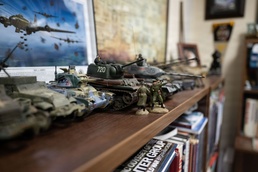
Now Airmen come to Paley with their own questions. He invites them into an office filled with model tanks and aircraft, photographs and three generations of military history, then begins explaining why their place in the story matters.
The child who once looked up from a page and asked, “Daddy, what’s D-Day?” has become the person others turn to for the answer.