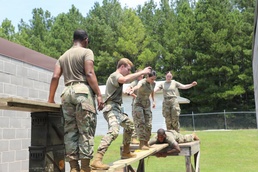
ANNISTON, Ala. — Standing in the August heat at the Clark Range complex, a squad of Alabama Army National Guard Soldiers faced a 15-minute countdown, a series of wooden planks, a pool and an obstacle designed to frustrate them. Ranks ranged from captain to specialist, but as the clock ticked down, insignias faded into the background.
The task required moving the entire team and a set of heavy equipment across an open span without touching the ground. Success depended entirely on whether a group of relative strangers could rapidly turn chaos into a cohesive plan.
On Aug. 1, 2026, junior enlisted Soldiers and junior officers from across the 167th Theater Sustainment Command and its subordinate units put their problem-solving skills to the test during annual training at the Leadership Reaction Course. The 16-lane facility challenges participants physically and mentally, forcing them to delegate, build trust and draw on the collective knowledge of their squads under tight time constraints.
Unlike routine unit training where team members already know each other's habits, cadre intentionally randomize squad rosters at the LRC.
"The LRC teaches junior officers and NCOs to work together as a cohesive team under pressure because we do not allow them to pick their own teams," said Sgt. 1st Class Avery Reddish, an operations and training noncommissioned officer assigned to the Special Troops Battalion, 167th TSC. "This requires that they work together with fellow service members that they may not be as comfortable with, on top of the pressure of a timer."
Reddish, who oversaw the iteration, noted that the course forces leaders to realize that no single person holds all the answers. The high-stress, short-deadline environment is built to expose weaknesses and teach Soldiers how to recover from inevitable setbacks.
"Failure is only truly a failure when you choose not to learn from it," Reddish said. "The pressure of the course and the timer is intentionally hard and at times unachievable, but learning how to grow from these mistakes and take honest criticism from your team can help you learn how to make the right choices in real-life situations down the road."
Once the mission brief ended, rank quickly became secondary to whatever each Soldier could contribute to the team.
Sgt. 1st Class Mary Little, a platoon sergeant assigned to the 781st Transportation Company, noticed how quickly the initial awkwardness dissolved into rapid execution once rank was set aside.
"We didn’t see rank out there. We had from captain to specialist," Little said, noting that it was her first time on a leadership obstacle course since basic training. "We listened to everybody's input."
Little explained that as the team completed their first lane, the team moved through subsequent obstacles more quickly.
"Working with each other, you get to learn everybody's weaknesses and their strengths so you can use that as an advantage," Little said. "We started working faster because we created that bond."
1st Lt. Daivon Allen, a logistics officer and platoon leader assigned to the 123rd Quartermaster Company, echoed the sentiment that rank holds no monopoly on good ideas.
"Just because you outrank somebody doesn't mean you're better in any aspect," Allen said. "They might be good in an area that you're not... So we come together—it's just that mindset and that mental strength. I might not be the strongest person, but I might have knowledge from past experience to bring it all together."
Allen highlighted the transformation that happened across the squad as uncertain plans turned into tangible results. "Going into the obstacle, you're brainstorming and you're kind of confident, but as you keep going, you see the success of the plan developing. It was just cool to see that growth—going from unsure to confident."
While the course aims to polish leadership traits, it also teaches the critical, often-overlooked value of followership and knowing when to yield to a teammate's expertise.
Pfc. Kaytlin Hogue, a religious affairs specialist assigned to the 167th TSC, admitted that stepping into a primary leadership role did not always come naturally to her, but the course offered clear insight into team dynamics.
"I’m not very much a leadership-type person; I don't really step up as much as I follow others," Hogue said. "It personally made me realize I need to step up as a leader sometimes and voice my opinions... but it also showed me my strength as a follower."
Hogue noted that having too many dominant personalities trying to direct a task simultaneously can paralyze a unit.
"If your pride gets in the way as a leader, it causes more drama or clashing," Hogue said. "Sometimes it's very good to just be like, 'Okay, use me where you need me.' But when no one steps up, someone needs to take charge. It needs to be a balance."
For assigned leaders, the course delivered a hard lesson in task management. Leaders simply did not have the bandwidth to micromanage every detail while the clock ran out.
"It teaches leaders how to delegate and trust," Reddish said. "If you assign someone to construct a platform, you do not have time to inspect every aspect. You have to trust that they did it correctly and move on to make sure the mission is accomplished in the time given."
For junior Soldiers like Spc. Dylan Cochran, an intelligence analyst assigned to the 167th TSC, the course was an exercise in personal growth and overcoming the fear of making mistakes.
"I would be the type to sit back, but this has shaped me to where I can lead, listen to those who know better, and fill in the gaps for my battle buddy," Cochran said. "It helps you grow from being prideful. Being wrong is fine—it's learning from it that matters."
Cochran added that the physical nature of the obstacles pushed everyone to support one another, reinforcing the idea that no Soldier reaches the objective alone.
As the 167th TSC wrapped up their time on Clark Range, cadre and participants agreed that the real value of the 16-lane course extends far beyond clearing wooden frames or balancing on ropes. The lessons learned on this course are skills Soldiers can carry into future missions.
"The key things senior leaders expect these young leaders to bring back are learning how to work as a team no matter who is on it, critical thinking skills, knowing how and when to delegate, and overcoming failure rather than letting it define you," Reddish said.