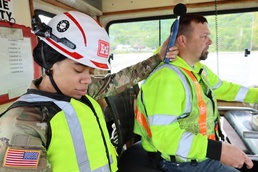
Both now and in the future, employees exposed to biological, chemical or physical hazards on the job receive ongoing monitoring and care to help keep them safe.
The U.S. Army Corps of Engineers’ Medical Surveillance Program provides occupational health oversight, enrolling employees based on their job duties and potential exposures, such as high noise levels, lead, welding fumes, silica dust and pesticides.
Medical screenings and exams are required to assess the effects of workplace hazards.
“We provide occupational health oversight for our employees who, while performing assigned duties, may be exposed to certain hazards at or above established action levels,” said Tina Shivel, occupational health nurse.
For example, the district’s Hearing Conservation Program is designed for employees exposed to high-noise environments, such as those working in the engine room of the Dredge Goetz, Shivel said. “We use noise dosimetry to monitor employees in high-noise areas. If their exposure exceeds a timeweighted average of 85 decibels, they are enrolled in the hearing conservation program. This ensures we’re protecting their hearing and acting before long-term damage occurs.”
Other examples include maintenance and repair crews working with concrete who are monitored for silica dust exposure. Air sampling helps determine if additional respiratory protection or controls are needed. Welders at Fountain Service Base are enrolled in respiratory protection programs, with regular monitoring to assess exposure to hazardous fumes.
“Medical surveillance isn’t a hindrance — it’s an investment in our employees’ long-term health,” Shivel said. “Some hazards, like silica, may not cause immediate illness, but can lead to serious health issues years down the road. By monitoring and controlling exposures now, we’re protecting our team for the future.”
Industrial hygienists play a key role in collecting data on workplace exposures, such as using air pumps to measure silica dust or monitoring welding fumes.
“You can’t always eliminate the hazard, but you can control it,” said 2nd Lt. Shaunna George, industrial hygienist. “If controls are effective, employees can be disenrolled from certain programs, but only after reassessment confirms the hazard is managed.”
Tailored and implemented at the local level, the program is not just about compliance — it’s about long-term health, she added.
“Many employees don’t go to the doctor regularly, so these screenings serve as their checkup,” Shivel said. “Physicals can include electrocardiogram, x-rays, and lab work and sometimes uncover other health issues that employees might not have known about.”
Initially, some employees were hesitant about the new program.
“There was resistance with the new program, but once we explained the reasons and benefits, employees became more receptive,” Shivel said. “Now, many are proactive, asking when their next physical is due.”
Physicals are provided at no cost to employees and are conducted during work hours. The program currently enrolls approximately 284 to 300 employees across operations, maintenance, dredging and other field activities.
The St. Paul District provides pre-employment, annual, and exit physicals, as well as continuous data collection and review. A contractor provides doctor oversight, ensuring that medical records are reviewed and employees are notified of any concerns.
The program’s success is also attributed to strong communication with supervisors and leadership, ensuring everyone understands the importance of participation and the process for enrollment.
“Our ability to build and maintain critical infrastructure depends on the health and well-being of our workforce,” said Aaron Pieplow, acting safety chief. “By investing in medical surveillance and workplace safety, we’re not only protecting our employees — we’re ensuring the continued success of our projects and the communities we serve today and for years to come.”
Each USACE district, division, or center is responsible for ensuring that its employees receive appropriate medical surveillance, in accordance with Army and Department of Defense regulations such as Army Regulation 40-5, Occupational and Environmental Health, and the Engineer Manual 385-1-1, Safety and Health Requirements Manual.