A routine Wednesday evening drive to church quickly became an unexpected call to action for Lt. Cmdr. Derek M. Henson, a Navy chaplain whose military training helped him provide lifesaving aid to a woman critically injured in a vehicle accident.
Within minutes, Henson, a Navy chaplain serving as Operations Officer for the Office of the Chaplain of the Marine Corps, found himself partially inside the wreck, holding a makeshift tourniquet around the severed arm of a woman he had never met.
His actions on July 29, 2026, helped keep her alive until emergency medical personnel could take over.
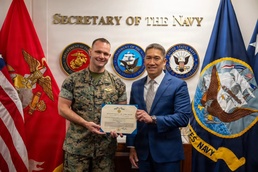
For those actions, Henson was recognized by Acting Secretary of the Navy Hung Cao during a ceremony Aug. 4, 2026, when Cao personally presented him with the Navy and Marine Corps Commendation Medal.
Henson said recognition was not on his mind when he saw the vehicle crash.
Henson and his family were traveling to church in Manassas, Virginia, when a vehicle approached from behind and moved into the opposite lane to pass.
The vehicle left the roadway, struck obstacles and rolled several times before stopping on the driver’s side in a nearby field.
“Everything seemed to happen in slow motion,” Henson said.
He immediately pulled over, asked his wife to call 911 and activated his hazard lights before running toward the wreck.
Two people were trapped inside.
Henson leaned into the vehicle and called out its occupants, letting them know someone was there to help. As he tried to assess their injuries, the driver told him her arm was trapped.
Henson reassured her that an ambulance was on the way, but the driver then informed him that her arm was gone.
Henson found an angle that allowed him to see the injury. The woman’s arm had been cut off near the middle of her forearm.
“At that moment, I knew time was critical,” Henson said. “In my mind, I knew that if I didn’t control the bleeding immediately, she likely wouldn’t survive.”
Henson’s response drew on skills he had first learned years before becoming a chaplain.
He initially reached for his own belt to create an improvised tourniquet, but another person at the scene handed him a leather belt. Unable to safely reach the woman through the windshield, Henson and another bystander tore away the vehicle’s sunroof to gain access.
Once inside, Henson wrapped the belt around the woman’s arm. He warned her it would hurt but she told him to continue.
Since the position of her arm prevented him from tightening the belt enough to control the bleeding, he manually twisted it until the blood flow stopped. With no way to secure the tourniquet at sufficient tension, he held it in place himself.
“I knew if I let go, she could start bleeding again,” Henson said.
While maintaining pressure, Henson remained in communication with the 911 dispatcher, passing information to responding emergency personnel and letting them know when the tourniquet was applied.
The woman stayed conscious, but Henson noticed she was drifting in and out. He asked his wife to come to the vehicle to help monitor the woman’s pulse while continuing to speak with her.
Henson asked the injured driver simple questions such as her name, her age and whether there was anyone they could contact, to keep her engaged and focused.
“More than anything, I wanted to keep her focused on our conversation instead of the severity of her injuries,” he said.
“Derek responded immediately and ran toward the accident,” said Autumn Henson, his wife, who was traveling with him at the time. “Everything happened so quickly, but he relied on his training and experience and did whatever he could to help the victims.”
For Henson, that training began long before he entered the Navy Chaplain Corps.
A native of Fair Grove, Missouri, Henson originally had no plans for a career in ministry, or even a lengthy career in the Navy.
Growing up with his parents and three brothers in rural Missouri, Henson planned to become a police officer. At 18, however, he learned he was too young to be hired and would need either an associate degree or military experience.
College did not appeal to him at the time, so he chose the Navy.
“My plan was to serve for a few years, gain experience, and then return home to work as a police officer in Springfield, Missouri,” Henson said. “Looking back, God had a much different plan for my life than I ever imagined.”
Henson served five years as a Master-at-Arms, the Navy’s military law enforcement rating, with assignments in Sigonella, Italy, and Ingleside, Texas.
During his early Navy career, he received first-responder training and later completed Emergency Medical Technician-Basic training. Those skills continued to be strengthened during his career through Tactical Combat Casualty Care and Survival, Evasion, Resistance and Escape training.
“By the time this happened, those skills had been practiced repeatedly, and they were like second nature,” Henson said. “My training absolutely prepared me for that moment.”
His path from Master-at-Arms to chaplain began taking shape while stationed in Italy.
Henson said he was trying to balance two different lives at the time, attending church on Sunday while spending much of his free time with friends.
A Navy chaplain, Lt. Tommy Myhand, challenged him to do more than simply attend worship. Myhand encouraged Henson to participate in Bible studies, develop relationships and become part of the church community.
Henson described the conversation as a turning point.
Then, in 2007, a close friend and his son were killed in a car accident.
Watching chaplains respond to the family during the aftermath had a deep effect on him. At the same time, he noticed fellow Sailors increasingly approaching him with questions about faith, suffering and life.
“Those experiences made it clear that God was calling me into ministry, and specifically into military chaplaincy,” Henson said.
He eventually left active duty, completed the education necessary for ministry and returned to the Navy as a chaplain.
Years later, standing beside a devastating car accident, the two separate parts of his Navy career came together.
“I believe every assignment, every deployment, and every conversation I’ve had as a chaplain helped prepare me for that moment,” Henson said. “My role has always been to bring a calming presence during times of crisis, and I think that carried over naturally.”
As Henson held the improvised tourniquet in place, he said his thoughts were not centered on fear, but on what might happen next.
He watched the woman’s condition and mentally prepared himself to respond if she stopped breathing or went into cardiac arrest.
“I knew her injuries were life-threatening, so my focus wasn’t on fear,” Henson said. “I just wanted to be sure I was doing everything I could to keep her alive until EMS arrived.”
When EMS arrived, they asked Henson to continue holding the tourniquet while they stabilized the vehicle and assessed the patient.
Responders then applied another tourniquet and began the process of removing her from the wreck.
After the immediate emergency had passed, Henson told one of the paramedics that he hoped he had done everything correctly.
“Yes, you did great,” Henson recalled the paramedic telling him. “It was perfect.”
Henson later provided a statement to police. The following day, an investigator called him to let him know the woman was alive.
Firefighters, first responders and others at the scene told Henson his actions had likely saved her life.
The experience, however, did not end when Henson walked away from the crash. He said processing what happened proved more difficult than he initially expected.
“It didn’t take long for me to recognize that I was experiencing some of the effects of trauma myself,” Henson said.
He turned to family members, trusted friends and fellow chaplains, including Chaplain Rick Shaffer, who encouraged him not to become consumed by questions about what could have happened differently.
What if he had been unable to stop the bleeding?
What if the overturned vehicle had shifted while he was partially inside?
What if his own family had been hurt?
“Those are natural questions after an event like this,” Henson said, “I’m just happy that I was able to help and knew what to do.”
For Henson, the experience also reinforced something he had long believed about the role of a chaplain.
“Chaplains are called to be present with people during the most significant moments of their lives, whether those moments involve joy, grief, fear or uncertainty,” he said.
His ministry that day did not take place behind a pulpit, inside a chapel or during a scheduled counseling session.
It took place beside an overturned vehicle, with a leather belt in his hands and another person’s life at risk.
“I’m incredibly proud of him, but what stood out to me was that he never stopped to think about himself,” said Autumn. “He saw someone who needed help, and he did everything he could for her. That’s Derek, and that’s the kind of chaplain he is.”
Receiving the Medal brought formal recognition to actions Henson said were never motivated by recognition.
Instead, he sees the events of July 29 through the same lens that led him from a young Master-at-Arms from rural Missouri to service in the Navy Chaplain Corps.
“I’m grateful that I was there and able to help,” Henson said. “I’m thankful God allowed me to be in that place at that time and equipped me to make a difference.”
For Henson, being there was the point.
“Serving as a chaplain means walking alongside people through every season of life, regardless of their background, beliefs or circumstances,” he said. “My primary responsibility is to be present, to care for people where they are, and to help connect them with hope, purpose and their faith.”