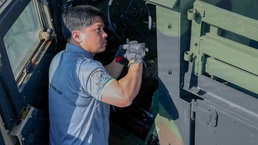
VICENZA, Italy — Moving U.S. military equipment across international borders requires more than transportation. It requires a customs operation capable of protecting the United States from agricultural threats, identifying and appropriately addressing prohibited or illegal items, and keeping forces and equipment moving between missions.
The U.S. Army Southern European Task Force, Africa (SETAF-AF) customs and border clearance program supports that mission across the African continent, integrating customs requirements into military movements while strengthening SETAF-AF’s ability to deploy, operate and redeploy forces and equipment.
“The U.S. Department of Agriculture inspector told us that SETAF-AF’s customs program is in the top 5% of the 114 programs they manage and inspect during the recertification of our program on June 17,” said U.S. Army Sgt. 1st Class James Vervaecke, chief customs agent and program manager for the SETAF-AF Operational Protection Directorate. “That recognition validates the work our team puts in every day, but more importantly, it shows the operational impact of what we do. Effective customs operations help SETAF-AF move equipment across multiple countries and ensure forces can deploy, operate and redeploy without unnecessary delays.”
Department of War-sponsored cargo destined for the United States must meet U.S. Department of Agriculture pre-clearance requirements and applicable customs regulations before entering the United States. Customs agents inspect cargo for agricultural risks and document compliance with USDA pre-clearance requirements using DD Form 2855. If contraband or illegal items are encountered during an inspection, agents handle and report them through the appropriate procedures; the DD Form 2855 certification itself documents agricultural pre-clearance and does not serve as a U.S. Customs and Border Protection or contraband certification.
“Any cargo that leaves the continent of Africa to go back to the U.S. must be inspected to ensure it meets USDA agricultural pre-clearance requirements,” Vervaecke said. “That means making sure there are no agricultural threats such as pests, insects or soil. As part of the broader customs and border clearance mission, agents also remain alert for prohibited or illegal items and follow the appropriate procedures if those items are encountered.”
The mission extends far beyond the team’s headquarters in Vicenza, requiring customs personnel to support equipment movements across Africa.
“The scale of what this team accomplishes is significant,” said Katherine Brennan, deputy director of SETAF-AF OPD. “In the past 12 months alone, our customs personnel have operated in 14 countries and inspected more than 10,000 pieces of military equipment and cargo for agricultural pre-clearance requirements. That capability directly supports our ability to move forces across the theater, complete the mission and get critical equipment where it needs to be for the next operation.”
Customs support is particularly important during multinational exercises such as African Lion and Justified Accord, when equipment moves across international borders before redeploying to Europe or the United States.
“Every country presents different requirements, timelines and challenges, so preparation has to begin well before equipment reaches the point of departure,” said Justineal G. Biteng, senior customs border clearance agent for SETAF-AF OPD. “Our job is to identify those requirements early, coordinate with the right organizations and help units move their equipment without creating unnecessary delays at the border or during redeployment.”
That preparation begins before equipment reaches a customs inspection point.
“A successful customs operation starts before the inspection,” Biteng said. “When units understand what is required and prepare their equipment correctly, we can move through the process much more efficiently. That coordination helps protect the United States while also helping commanders get their equipment back where it needs to be for the next mission.”
The program is also exploring technology to improve inspections of enclosed and difficult-to-access areas of military equipment.
“Some of the things that they highlighted for us was our dedication to innovation and innovative technologies,” Vervaecke said. “We've been exploring other innovative ideas and tools and equipment to allow us to better conduct our operations, such as handheld X-ray scanners, endoscopic cameras, density meters and thermal imagers.”
Those technologies could expand how agents inspect areas that are difficult to assess through conventional visual inspections.
“Innovation matters when it solves an operational problem,” Brennan said. “These tools can give our agents better visibility into areas they otherwise could not easily inspect. That helps us conduct thorough inspections while keeping equipment moving through the redeployment process.”
Training remains central to maintaining consistent standards across the program’s broad operating area.
Vervaecke, a Soldier in the U.S. Army Reserve serving on active-duty operational support orders, brought 13 years of civilian law enforcement experience to the program. His background as a sheriff’s deputy and police officer helped strengthen training and standardize customs inspection procedures, a subtask of military police operations.
“What I’m most proud of is the consistency and professionalism of this team,” Vervaecke said. “We operate in different countries under different conditions, but the standard does not change. Our agents understand the importance of getting every inspection right because what we do directly affects the movement of equipment and the readiness of the force.”
Each completed inspection also contributes to the next movement of equipment and the force’s ability to prepare for follow-on missions.
“When you see thousands of pieces of equipment successfully inspected and cleared through the required processes, you understand the impact,” Biteng said. “Every inspection supports the next movement, the next exercise and the next mission. Our responsibility is to make sure we do it correctly every time.”
For SETAF-AF, customs operations support a broader requirement to maintain freedom of movement into, across and out of Africa while preserving equipment needed for future missions.
“Readiness includes the ability to move,” Brennan said. “This team helps ensure that when our Soldiers complete a mission in Africa, their equipment can return safely, legally and ready for what comes next. That makes customs an important part of how SETAF-AF maintains operational reach and readiness across the theater.”