The Air Force brought five vendors to the 178th Wing in Springfield, Ohio to test rapidly deployable Command and Control Enclave prototypes Aug. 5-7 in an environment similar to those where airmen could eventually use them: within an expeditionary combat situation.
Rather than selecting a single piece of technology and testing it later, Air Force officials used the demonstration to compare multiple prototypes at once and gather feedback from the operators who could ultimately use the technological capabilities of the equipment.
“What we got to do this week is we brought out five vendors and they demonstrated prototypes of their rapidly deployable portable control segment,” said Michael Schneider, lead engineer for the Command and Control Enclave, or C2E. “This is part of our overall acquisition strategy of identifying who the right integration partner is for the C2E program.”
The approach allows the Air Force to evaluate multiple solutions simultaneously before committing to a single technology, helping officials identify the right integration partner on an accelerated timeline.
Capt. Robert Anderson, C2E lead program manager, Collaborative Combat Aircraft (CCA), said the approach allows the Air Force to incorporate promising technology quickly while ensuring the selected capability meets all requirements.
“We left the door open for them to pick what they think is best to meet our requirements as soon as possible,” said Anderson.
The 178th Wing provided more than a location for the demonstration. Its existing infrastructure, proximity to Wright-Patterson Air Force Base and partnerships with organizations involved in emerging technology made it a useful environment for testing prototypes.
“When we reached out, we saw that the 178th was uniquely positioned for a few reasons,” said Lt. Col. Gregory Bieler, the materiel leader, CCA. “The first was the Sky Vision partnership with the Air Force Research Laboratory and National Advanced Air Mobility Center. Some of the work they’re doing is going to make it really easy to continue to grow the mission autonomy and test space.”
Those partnerships are part of what the 178th Wing can offer as the Air Force looks to develop and field emerging capabilities. Col. Donald Braskett, 178th Wing commander, said the wing’s location and existing expertise give it an advantage in supporting that work.
“The 178th Wing is uniquely positioned to provide Air Force Life Cycle Management Center with an immediate, cost-effective solution for advancing the Collaborative Combat Aircraft program,” Braskett said. “Our strategic location near Wright-Patterson Air Force Base, coupled with our infrastructure and expertise in unmanned operations, creates a powerful combination.”
The demonstration was intentionally conducted in a simulated tactical environment rather than a controlled indoor setting.
“We didn’t want to be sitting behind closed doors or in a vault somewhere, because that’s not how our airmen are going to use this system. We wanted to be out in the open in a relevant environment,” Bieler said.
The outdoor setting also gave vendors and Air Force personnel a more realistic environment in which to evaluate the prototypes.
The demonstration also put operators into the acquisition process, allowing the people who could eventually use the technology to influence how the capability is developed.
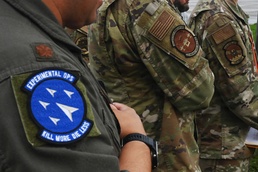
“As part of the Secretary of War’s acquisitions transformation initiative, it’s really important that we do a couple things when we make major technological decisions like this,” Bieler said. “The first thing is that we partner with our operational counterparts, such as the experimental operations unit.”
Schneider said bringing different organizations and perspectives together at the 178th helped move the process forward. The Agile Development Office, or ADO, was among the organizations represented during the demonstration, along with the Experimental Operations Unit and Air Combat Command. For the 178th, hosting the demonstration also showcased how its existing infrastructure, expertise and partnerships can support the Air Force’s investment in emerging capabilities.
“The other thing is that just the responsiveness and the willingness to host of the 178th was bar none the best I’ve ever had in my entire Air Force career,” Bieler said. “To me, when I look at getting stuff for the warfighter, the 178th was willing just to make it work and not worry about bureaucracy and everything else to help us get that.”
The demonstration could also serve as the beginning of a longer-term partnership between the 178th Wing and organizations developing future autonomous capabilities.
“We did this here not only because of the responsiveness, but I also think there’s a long-term opportunity from collaboration between the CCA team, the 178th, and hopefully, mission autonomy as a larger enterprise,” Bieler said.
“What we’re building here has a multiplicative effect across the Air Force, and so we’ve got to get it right, and we’ve got to get the right perspective in here,” said Schneider.
The demonstration gave the Air Force an opportunity to evaluate emerging technology before committing to a final solution while giving operators a voice in how that capability could ultimately be used. For the 178th Wing, the event also demonstrated how its infrastructure, expertise and willingness to support emerging missions can contribute to the development of capabilities designed for the future fight.