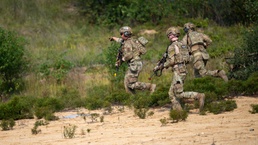
In the forest near Camp Grayling, Michigan, the rumble from a Humvee’s diesel engine slices through the darkness as it creeps down a dirt road, snapping tree branches under its tires.
Just off the road, hidden in the thick brush, a joint team of U.S. Army Green Berets and Air National Guard security forces Airmen sit motionless. No radio noise, no words can be heard, as the team waits for their target to breach an ambush site. In an instant, the silence is shattered by gunfire from the tree line, bringing the Humvee to a stop.
The tactical ambush was just one scenario for nearly 200 ANG, and a handful of Air Force Reserve, security forces Airmen who descended upon northern Michigan for Exercise Sage Eagle 26-4, Aug. 3-14, 2026.
Sage Eagle, nested under the National Guard Bureau’s larger Northern Strike exercise. is a joint staff accredited readiness exercise designed to push Airmen far beyond just basic base security operations.
Throughout the two-week event, Airmen served as both simulated partner forces and opposition forces for Operational Detachment Alphas and Bravos (ODAs and ODBs) from the 2nd Battalion, 5th Special Forces Group out of Fort Campbell, Kentucky.
"Our Air National Guard members have been partnering directly with ODAs," said Lt. Col. Dustin Eaves, a Sage Eagle liaison officer and commander of the 186th Air Refueling Wing’s Security Forces Squadron based out of Meridian, Mississippi. "These Green Berets are the best in' the business, and they train our Defenders on small-unit tactics, irregular warfare, and light infantry maneuvers.”
The exercise validated core mission essential tasks for the Green Berets and enhanced their ability to support various combatant commanders across the globe, Eaves said He also noted the high-tempo training simultaneously covered roughly 75% of security forces wartime taskings in just 14 days.
The Green Berets touted the opportunity to partner with ANG guardsmen as it provides unmatched training realism that active-duty counterparts cannot easily duplicate.
"Special Forces often operate as an enabler for conventional military operations—we are the scalpel that eliminates unique problems and removes roadblocks so the larger force can accomplish the overall mission," said Mike, a mission planner for the exercise. "Working alongside Air National Guard Security Forces sharpens our ability to mentor, advise, and fight through any contested environment."
The demanding training schedule immersed ANG Defenders in small-unit tactics, live-fire maneuvers, and meticulous mission planning.
“We started out with the basics, a crawl, walk, run approach through small unit tactics and then we moved into irregular warfare,” said Tech. Sgt. Dane Bakken, a security forces Airman from the 115th SFS, based at Truax Field, Wisconsin. “Our first op was like three days’ worth of planning, and we executed it in about 20 minutes. If you think about it from a real-world application, if all that planning goes in and they can get in and out in 20 minutes, that’s a good thing.”
Eaves compared the training repetitions required during this exercise to football practice.
“It's very much like a football team, like football practice,” said Eaves. “During a practice, you run play after play after play, and if you don't run the play right, you do it again. You run it again and again. And what that does is that makes you better for when you're going out in the game. You're able to run those plays more efficiently and more smoothly because you then understand how to do it at a better, quicker, more accurate pace because of the reps and sets that you did at practice.”
These principles that were reinforced by the Green Berets will have an immediate impact as Airmen return to their respective wings.
“The two things the Green Berets like to see are repeatability and predictability,” said Bakken. “Those two key pieces I am taking back to my unit. Doing hard things makes the basics come easier. You come out here, you put in the sweat, and it sharpens every tool in your tool belt.”
Traditional Guardsmen bring a diverse background of civilian experience to the fight and they naturally reflect the varied partner forces the Green Berets train and advise around the globe.
“We get to put them through situations they wouldn’t be able to replicate without us,” said Tech. Sgt. Tyler Cannon, a 124th SFS Airman from the 124th Fighter Wing, Boise, Idaho. “We bring in traditional guardsmen and they fill the role really well because of their civilian jobs and experiences. We get to put them through situations that they wouldn’t get without us, where they are learning how to deal with real-world situations downrange.”
Not only does this adaptability under pressure enhance the Green Berets combat effectiveness, it allows Airmen to demonstrate that they are lethal forces that are always ready for the warfight.
“This type of training, it's not easy,” said Eaves. "At the end of two weeks, these Airmen can hold their heads high, look back at what they accomplished, and know they are ready for whatever call comes next."
As quickly as the gunfire erupted, the Humvee is destroyed, the gunfire ends, and the forest returns to pitch black darkness and silence as the Green Berets and Airmen disappear into the night.