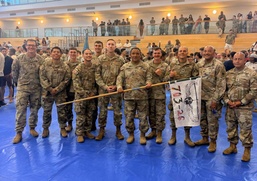
VICENZA, Italy — Eight U.S. Army Southern European Task Force, Africa (SETAF-AF) Soldiers earned their Air Assault wings after completing the 10-day Air Assault School at 7th Army Training Command’s Grafenwoehr Training Area, Germany, Aug. 14, 2026.
Their path to graduation began weeks before they arrived at the course, with SETAF-AF assessing candidates to ensure Soldiers selected for the limited school seats were ready to meet the physical demands.
“We wanted to make sure we were sending Soldiers who were prepared to succeed,” said U.S. Army Sgt. 1st Class Juan H. Lopez Gonzalez, operations noncommissioned officer and Air Assault School planner with Headquarters and Headquarters Battalion, SETAF-AF. “The candidates completed the obstacle course and the 12-mile foot march, and those who met the standards were the ones we selected to attend the school.”
The deliberate selection and preparation process brought together Soldiers from different ranks and specialties across the command. Their success increased the number of air assault-qualified Soldiers within the formation while reinforcing a culture of readiness and professional development.
Preparing Soldiers before they arrived at the course also helped turn limited training opportunities into an investment in setting them up for success as students.
“Sending Soldiers to challenging schools is an investment in the readiness of our formation,” said U.S. Army Command Sgt. Maj. Lorenza P. Souza, senior enlisted advisor for HHBN, SETAF-AF. “We want to give our Soldiers opportunities to develop, but we also have a responsibility to prepare them to succeed. These eight graduates demonstrated the discipline, resilience and commitment we expect from our Soldiers, and they brought those skills back to make the entire team stronger.”
Even after selection, individual preparation remained essential for the candidates. U.S. Army Capt. David A. Grosmick, an engineer officer and exercise planner assigned to SETAF-AF, followed a 12-week, foot-march training program that progressively increased weight and distance while incorporating regular physical training and calisthenics.
That physical foundation allowed students to focus on the technical demands of the course, where repetition and teamwork became especially important during sling-load operations.
“The most challenging part of Air Assault School was during phase two when we had our sling-load inspections,” Grosmick said. “We overcame that as a team primarily by conducting many repetitions and inspecting the equipment we were getting our hands on.”
Success during the technical phases required more than memorizing procedures. Students had to consistently apply detailed instructions while performing under pressure.
“The key takeaway from the course is definitely attention to detail,” Grosmick said. “You have to pay attention to the instructions the cadre are giving you and follow them exactly.”
The course also provided Soldiers an opportunity to pursue goals outside their normal duties and test themselves in an unfamiliar environment.
“I've watched videos of air assault before I enlisted, and I always thought that was something I would love to do,” said U.S. Army Pfc. Joshua Lambert, a visual information equipment operator-maintainer assigned to SETAF-AF. “When I got asked, I said, ‘Yes, please send me.’”
Once training began, teamwork became critical to mastering the sling-load inspection process. Students worked together to rehearse the required sequence, identify missed steps and correct deficiencies before testing.
“There were a lot of repetitions and hands-on experience,” Lambert said. “Even after the official training hours were done, the instructors let us continue to train for an extra hour if we wanted to, and I made sure to capitalize on that.”
Repetition built technical proficiency, but maintaining focus remained equally important as students moved between physical events, classroom instruction, written examinations and hands-on evaluations.
“The information is straightforward, but if you're not paying attention or you're distracted, your mind can go blank when you're doing the hands-on inspections,” Lambert said. “Trust what the cadre are teaching you and use that as the launch pad for success.”
The lessons developed during the 10-day course extended beyond earning Air Assault wings. Attention to detail, teamwork, physical readiness and the ability to perform under pressure were skills the graduates could bring back to their respective sections and missions across SETAF-AF.
The experience also reinforced the value of Soldiers actively pursuing opportunities that challenge them and expand their capabilities.
“If you want the opportunities, ask for them and keep pushing for them,” Lambert said. “Once you get there, fully immerse yourself in the environment. Give maximum effort, keep showing up and don't stop.”
By combining individual initiative, deliberate preparation and leader investment, the eight graduates returned to SETAF-AF better prepared to contribute across the formation. Their achievement added trained capability to the command while demonstrating how challenging Army schools can strengthen both Soldier development and organizational readiness.
The Air Assault School graduates included U.S. Army Capt. Thomas Shedlick, SETAF-AF signal plans officer; 1st Lt. Racos J. Martinez, theater logistics planner, 79th Theater Sustainment Command; Sgt. 1st Class Elisban A. Bazan, 79th TSC; Staff Sgt. Juan J. Barragan, noncommissioned officer in charge of chemical, biological, radiological and nuclear, Operational Protection Directorate, SETAF-AF; Spc. Jorge Garcia-Fregoso, movement specialist, 79th TSC; and Pfc. Logan Doll, geospatial engineer with SETAF-AF.