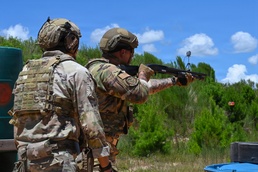
HURLBURT FIELD, Fla. — The 31st Air Task Force sharpened and refined a layered counter-small unmanned aerial system defense capability, culminating in a kinetic “final denial” live-fire demonstration, August 3-7, 2026.
The week-long training event built on counter-sUAS initiatives first employed during the ATF’s February field exercise and increased knowledge among Airmen assigned to the 31st ATF and the 31st Combat Air Base Squadron.
“Through a crawl, walk, run approach, Airmen gained practical knowledge of a full spectrum of layered counter-sUAS capabilities,” said the 31st ATF’s force protection superintendent. “The ATF is posturing to provide tiered defense through detection, electronic warfare defeat, and physical interception of hostile drones.”
Throughout the week, Airmen trained on AI-powered systems that detect, track, and filter aerial objects from planes and drones to birds. They also improved real-time data sharing across multiple levels of command and control from an expeditionary base defense operations center.
The 31st ATF hosted leaders from Air Force Special Operations Command and the 1st Special Operations Wing, joining experts on drone warfare, precision munitions, and unmanned threat detection and mitigation. They explored the latest ways to protect the warfighter and counter emergent UAS threats.
“It’s inspiring to see a unit at this level proactively tackling a problem-set that is top of mind for leaders across the Air Force and the Department of War,” said 1st SOW Deputy Commander, Col. Clayton Schuety. “The blend of entrepreneurial foresight, AI surveillance, and human-directed targeting will no doubt create positive impacts for the warfighter. We look forward to seeing how this effort continues to mature and receiving the lessons learned which will benefit Air Commandos and the larger force.”
By teaming with top industry partners and using existing Air Force equipment, the 31st ATF trained Airmen on weapons designed to defend against hostile drones and safeguard against electromagnetic warfare threats. Airmen practiced organic reconnaissance and denial of high-speed sUAS targets mimicking hostile flight patterns.
“The team successfully executed a capstone event that validated new tactics, techniques, and procedures across force protection and distributed communications,” said 31st ATF commander, Col. Brad Dvorak. “Our mission is to enable airpower operations, anytime, anywhere. By establishing a sUAS instructor cadre, we trained our personnel on counter-sUAS architecture and employed unique solutions for Airmen to track, jam, and kinetically defeat sUAS threats.”
The 31st ATF is a combat-ready unit of action bringing competitive advantage to meet pacing challenges. The wing, commanded by an Air Force colonel, consists of a command-and-control element and a combat air base squadron with up to 2,500 Airmen across more than 60 Air Force specialty codes. The team can provide base operating support for deployed flying units, also known as mission generation force elements,and the necessary logistics to execute agile combat employment.