This is part of a series focused on the U.S. Army Command and General Staff College’s newest elective: AI Basics. The series describes the elective, executed as part of the Command and General Staff School’s Command and General Staff Officer Course in academic year 2026. It includes testimonies from Soldier Developers who are graduates of CGSOC, the course, and producers of a no-code software product.
FORT LEAVENWORTH, Kan. – While artificial intelligence is transforming fire and maneuver, the U.S. Army Command and General Staff College is ensuring every warfighting function, including the Chaplain Corps, leverages the technology to modernize support to the force.
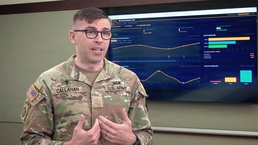
Through the new AI Basics elective course, students like Maj. Sean Callahan, 65A, Chaplain, are building custom AI agents to increase efficiency, preserve institutional knowledge, and return valuable time to mission-critical tasks.
Callahan explained, before attending CGSOC, he used artificial intelligence for product reviews and basic knowledge.
A healthy degree of skepticism about AI followed Callahan into the AI Basics course, but was quickly dispelled, encouraging the creation of Callahan’s Chaplain Corps-focused, Chaplain Administration Platform, CHAP, in just a few weeks.
Seen as a balance of AI theory and how AI works and practical application, Callahan took the elective as a means of closing a professional development gap on the technology.
"...At the very least, it would serve as a personal innovation lab where I can make mistakes and it would be low threat, low risk,” he said. “Or I could ask a lot of questions, where I could experiment, and perhaps, at some point, gain more of an understanding of it, and build at least a vision of a tool or a tool itself for the future.”
The elective’s focus on prompt engineering was a focal lesson for Callahan, illuminating the importance of information put into the Large Language Models.
In addition, using AI to improve itself or the output was also a key curriculum outcome.
“One of the things that was very helpful to me was learning how to use AI to craft the prompts to build things with AI, sending it back and forth to different LLMs to learn where my gaps were, what I should consider, what guardrails I should put into place,” Callahan said. “An AI was way better at doing that than I am."
Beyond the actual curriculum, Callahan explained the small-group structure of CGSOC courses enhanced the idea share and experimentation with AI.
“When you bring a student body like this here at CGSC together for a class in AI, and you have this diversity of warfighting functions, what that brings to the table is a diversity of knowledge and experience and perspective,” Callahan said. “We can all sit down and look at the same problem set. But what a maneuver officer might see and how they approach the problem be different than I approach it. What that does is it enables them to see things we don't see, create solutions we didn't realize we even needed.”
An unexpected second peer in the room was AI, Callahan said, providing another avenue to explore ideas and problem sets and enhance decision making.
“I saw it as good stewardship of the profession...you see AI as a tool that can do things more rapidly and efficiently than humans can, depending on what the task is,” he said. “I think in many ways, its best use is making routine tasks done routinely and easily for the warfighters so that they can focus on things that only they can do, much like we were doing in the chapel community.”
Like his peers of the elective, Callahan was challenged to create an AI agent that could solve a problem within their next unit of assignment.
Callahan went one step further focusing his efforts on the Chaplain Corps as a whole.
He created CHAP, a replicable AI agent to assist in chapel community administrative management and enabling leadership decisions.
His main focus behind CHAP was to let the agent handle the day-to-day resource, maintenance, and facilities thinking, to free religious support specialists space to support the spiritual readiness of the force.
For Callahan, CHAP’s purpose was two-fold.
“One, the chapels are incredibly important to our core competencies of nurturing the living, caring for the wounded, and honoring the fallen. In order to maximize our time spent doing those things, we can leverage AI to alleviate some of the administrative burden,” he said. “Ultimately then informing and driving commander’s decisions both how they obligate their finances at the garrison level and how they're managing their facilities.”
Chaplains Corps, much like other branches, experience high turnover rates, which according to Callahan, CHAP makes transitioning of chaplains and religious support specialists less disruptive to a unit.
“I asked, ‘how could I create some kind of tool or process that could be transferred in between posts so that it's something that's readily accessible and known and there's very little deviation?’” he explained. “How can we turn that tacit knowledge into explicit knowledge? Like turning institutional knowledge to SOPs or readily accessible videos, but then back to tacit knowledge to form a scaffolding, to build up a lot of the newer and younger soldiers, NCOs, chaplains.”
Read more on the AI elective here: https://www.army.mil/article/293998/new_army_command_and_general_staff_college_course_creates_ai_sharpshooters
Interested in other graduate experiences? Read one here: https://www.army.mil/article/294778/stack_ing_the_odds_in_the_army_signal_corps_favor_a_soldier_developers_point_of_view_of_cgscs_ai_basics_course