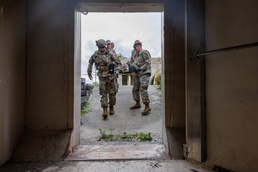
Providing medical care in an expeditionary environment is a challenge, even under the best of conditions. Casualties require evaluation, treatment, and possible evacuation all while potentially under fire. Airmen are required to complete Expeditionary Medical Support (EMEDS) certifications, which prepare them to function in these environments. Exercise Northern Strike 26-2 increased the complexity of this situation by adding a persistent threat from unmanned aerial vehicles (UAVs).
“Drones are a very real threat, and our medical Airmen are not prepared through their typical medical training to handle these UAVs,” said U.S. Air Force Maj. Sarah Blackthorne, Northern Strike Air Component medical planner. “We developed a drone stress inoculation event testing how they might evacuate a field hospital.”
The scenario saw several UAVs deployed against a field hospital at the Alpena Combat Readiness Training Center. They were mitigated using anti-drone netting and small arms fire. After the threat was neutralized, a quadruped unmanned ground vehicle was deployed to inspect the downed drones, and patients were evacuated.
“The concept of the drone nets came from Ukraine," said Blackthorne. “The specific type of netting is supposed to be impenetrable by most drones, creating large tunnels that casualties could be evacuated through.”
“Evacuation always includes taking your patients with you,” she continued. “The evacuation to the secondary facility was actually into an underground medical facility.”
According to Blackthorne, the facility was built during the Cold War as a hardened medical shelter. She believes the bunkers serve as an ideal training tool and mimic the types of facilities military medical professionals are utilizing in Ukraine.
The overall medical footprint for the exercise featured more than 100 active-duty and Air National Guard medics from seven units. Approximately 60 of those Airmen were going through the EMEDS course, which teaches rapid, scalable, and forward medical care in operational environments.
“We don't want it to be the first time they experience UAVs on deployment,” said Blackthorne. "Opportunities to get exposure here to those things, where they can work through the stress, are valuable.”
Ukrainian military doctors in attendance shared their experience from the frontlines, which helped inform participants with the realities of UAV threats. “The threat of a drone attack in theater is a real and current threat,” said U.S. Air Force Col. Patrick D. Frank, Michigan National Guard Joint Forces Headquarters deputy director of staff - Air. “One of the largest lessons learned here was the need to go underground more. The Ukrainian doctors discussed with the medics and leadership about how tents are okay, but underground is better.”
The drone incursion had dozens of observers from across the Air Force’s total force medical hierarchy, including Lt. Gen. John J. DeGoes, Air Force Surgeon General and commander of the Air Force Medical Command.
“As the threat environment changes, we need to change as well, along with the techniques we utilize,” said Frank. “It is important to work through these scenarios to not only be ready for the current threat but also be mentally ready.”
Northern Strike is an Army sponsored, multi-component, multinational exercise designed to build readiness and enhance interoperability to fight and win. Northern Strike 26-2, Michigan’s largest and longest joint readiness exercise, was held from August 1 to 15, 2026 at the National All-Domain Warfighting Center. This year’s exercise featured around 9,000 participants.