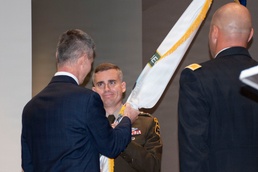
Huntsville, Ala. — The Project Manager Aircraft Survivability Equipment (PM ASE) held a change of charter ceremony between Col. Brock Zimmerman and Col. Curtis Brooker on July 24.
PM ASE manages the systems that detect, alert, and help protect aircraft from threats. With PM ASE under CPE Aviation, the Army ensures survivability technology is more closely integrated with aircraft development and long-term modernization priorities.
Mr. Rodney Davis, CPE Aviation, conducted the change of charter ceremony July 24 at the Auburn Research and Innovation Campus in Huntsville, Alabama.
“The ASE mission is one that everybody can get behind,” Davis said. “Survivability, keeping soldiers alive, allowing them to do things on the battlefield, is important. You can get behind that regardless of where you come from or what you feel.”
As the ASE Project Manager, Col. Curtis Brooker will guide current and future advancements in aviation survivability, ensuring the Army’s aircraft remain protected and ready for operations in increasingly contested environments. His leadership will shape how survivability solutions are fielded, sustained and integrated across the Army’s aviation fleet.
Brooker is a seasoned Army leader with extensive experience in infantry operations, acquisition program management, and strategic advising. He has commanded multiple units, deployed in support of Operations Iraqi Freedom and Enduring Freedom, and led key modernization efforts across PEO Soldier, Ground Combat Systems and PEO Missiles and Space. Most recently, he served as PM for Force Protection at PEO I&EWS (Intelligence, Electronic Warfare and Sensors) and later as the Military Advisor to the Deputy Under Secretary of the Army. His career reflects a broad portfolio of tactical, operational, and acquisition expertise, supported by numerous awards for valor, meritorious service, and combat excellence.
“My philosophy is simple — empower the team, and the mission will follow,” Brooker said following accepting the ASE charter. “Our mission is to ensure safe, survivable aircraft for our warfighters, maintain a threat‑ready force, and most importantly, take care of our people.”
COL Zimmerman Retires After 24 Years of Service
The charter transition comes as Col. Brock Zimmerman retires following more than two decades of distinguished service. Since July 2021, Zimmerman has served as the ASE project manager, leading critical efforts to reduce aircraft vulnerability during current combat operations and enhancing long term aircrew survivability with new and improved ASE systems coming online in the near future. Under his leadership, PM ASE delivered survivability improvements that strengthened Army aviation readiness and laid a foundation for continued modernization under CPE Aviation.
Brig. Gen. Kevin Chaney, Deputy Portfolio Acquisition Executive for Maneuver Air, officiated the retirement ceremony immediately following the Change of Charter.
“Under Col. Zimmerman’s leadership, his team worked tirelessly to develop world class survivability systems,” Chaney said. “The Army is losing an exceptional leader today, but we are a better, stronger, and more lethal force because you served in our ranks. You have lived our core values, led from the front, and left an indelible mark on the institution.”
A native of Hoopeston, Illinois, Zimmerman’s career includes deployments to Kosovo, Iraq, and Afghanistan; command of the Loves Park Recruiting Company; and key acquisition roles supporting armored brigade combat teams, information warfare, and Army-level modernization. He retires with numerous awards, including the Bronze Star Medal and Meritorious Service Medal.
Chaney presented Zimmerman with the Army Legion of Merit medal during the ceremony, along with the Presidential Certificate of Appreciation, a U.S. flag and Certificate of Retirement.
“After 29 years of service in this uniform, I stand before you humbled, grateful, and deeply proud,” Zimmerman said. “Not of any personal accomplishments, but of what we have achieved together.”
“I’ve never accomplished anything worthwhile alone,” he added. “Every operation that succeeded, every crisis we navigated, every unit that grew stronger, did so because individuals set aside ego, leaned on one another, and worked as one. Teamwork isn’t about coordination — it’s about trust, shared sacrifice, and the willingness to lift others higher than yourself. That spirit is what makes our military extraordinary.”