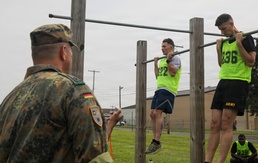
JOINT BASE MCGUIRE-DIX-LAKEHURST, N.J. – “I'm really proud of you for going the extra mile and working hard,” said Maj. Gen. Scott Linton, commanding general of the U.S. Army Reserve’s 99th Readiness Division, during a ceremony here Aug. 16 to award two foreign service badges.
Soldiers, Army Cadets, Airmen, and a Marine signed up to test their physical and mental limits in pursuit of two highly coveted foreign awards: the German Armed Forces Proficiency Badge, and the German Armed Forces Badge of Marksmanship known as the Schützenschnur.
“You went outside of your own comfort zone, outside the box, and you overcame challenges that were presented,” said Oberst i.G. Stephan Lissinna, German Army Senior Liaison Officer. “By doing that, you did the best thing you could do – you developed yourself, getting ready for the ever-changing future battlefield.”
The multi-day competition began with the physical assessments of the GAFPB.One of the most daunting hurdles is the aquatic challenge, requiring competitors to complete a 100-meter swim in their military uniform in under four minutes, followed immediately by removing their uniform while treading water.
Once out of the water, competitors were challenged with the Basic Fitness Test, comprised of an 11x10-meter sprint, flexed arm hang, and 1,000-meter run.
Competitors transitioned from physical endurance to tactical precision at the live-fire range for the Schützenschnur.Partnering with German military liaisons, U.S. troops aimed to earn their marksmanship badge, firing a series of qualifying shots from the standing, kneeling, and prone positions.
“The tradition of the marksmanship competition goes back 300 years,” said Lissinna explained. “It started with the Prussian king Frederick William I, and then later Frederick the Great, who wanted to increase lethality in their Armies.”
The finale was a strict timed-and-distanced weighted ruck march required to qualify for the gold, silver, or bronze badges.
In total, 230 awards were earned – 13 gold, 73 silver, and 24 bronze badges for the GAFPB, and 33 gold, 56 silver, and 31 bronze badges for the Schützenschnur.
“I want you to be proud of the award you’re getting,” Linton shared. “It not only represents the work that you put into this, it not only represents you as a warrior, but it also represents Germany and our allies and all the people around the world who wear it.”
In water and on land, competitors from multiple military branches, alongside international allies, radiated true grit – demonstrating what it takes to be prepared both physically and mentally while maintaining readiness, sustaining interoperability, and showcasing lethality.