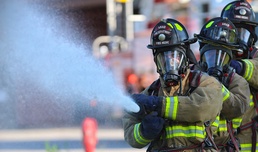
ANNISTON ARMY DEPOT, Ala. – Anniston Army Depot and City of Anniston firefighters conducted joint fire attack training during a controlled burn of a residential structure on July 20, 2026, reinforcing the importance of a mutual aid agreement ANAD has with surrounding municipal fire departments.
“The City of Anniston Fire Department’s chief extended his thanks and appreciation to our garrison for supporting their fire operations, as municipal fire hydrants and water supply in Wellborn, a residential area in Anniston, are minimal,” said Lee Batey, ANAD’s chief of Fire and Emergency Services Division.
The training demonstrated the depot’s commitment to supporting neighboring communities, while meeting the requirements of live fire and joint mutual aid training for the ANAD firefighters. It also creates a stronger, more coordinated emergency response system that is mutually beneficial, especially during incidents that exceed the capacity of a single department.
“In turn, those agencies can provide support to Anniston Army Depot for incident mitigation on the installation,” said Batey. “These aid agreements provide a means for supplemental resources, personnel and equipment when agencies are overwhelmed with call volume or the incident is a large-scale emergency.”
In an emergency, training makes all the difference. Scenarios like the residential structure-controlled burn simulate realistic emergency conditions that require communication, teamwork and quick decision-making. The training allows firefighters to become familiar with each other’s equipment, procedures, communication methods, and command structures while ensuring every responder understands their role during mutual aid response.
“Having properly trained personnel with the right equipment and support from each other is the goal of fire department training and operational preparedness. Agencies who collaborate and train together ensure their crews can arrive at emergency scenes and seamlessly execute critical functions under intense pressure safely and successfully,” said Batey.
The mutual aid agreement is an example that the strongest emergency response is built on teamwork, preparation and a shared mission to protect those they serve.