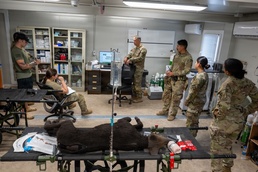
Through proactive training, Chabelley Airfield medical staff and the Combined Joint Task Force - Horn of Africa Veterinary team are providing critical backup care to service members to best support military working dog (MWD) teams. This initiative directly supports the installation's enduring priorities of defending the base and sustaining operations.
To maximize crisis readiness, CLDJ medical staff took part in a comprehensive Tactical Combat Casualty Care (TCCC) training event at Chabelley Airfield on July 24, 2026.
“This training is essential for the joint force, empowering our medics to overcome the limitations of distance and time in emergency canine care,” said U.S. Air Force Master Sgt. Jessica Martinez Santana, CJTF-HOA kennel master. “If a handler is incapacitated, this program ensures our Military Working Dogs still receive immediate, lifesaving care.”
The transit time to a veterinary facility can mean the difference between life and death for our MWDs, making these frontline medical skills absolutely critical.”
The training focused on treating critical field emergencies, venomous bites, heat-related injuries, and chest, limb, or eye trauma.
Because CADJ operates without a permanently stationed, full-time veterinary team, these CJTF-HOA partners are training the base medical staff to step in as primary first responders for injured canines.
"We want to make sure these dogs are cared for properly throughout all installations," said U.S. Army Colonel Adam Wiechman, CJTF- HOA veterinarian. "When we train medical staff and service members in K-9 TCCC training led by our team, we enable non-veterinary personnel to assist the MWDs in medical emergencies. The unfortunate geography of the HOA area of responsibility means the vet teams may be up to four hours away.”
The training utilized an advanced ‘Diesel’ K-9 training aid. This training aid is a high-fidelity powered simulator that breathes, bleeds, and has realistic vital signs; it is exceptionally rare in deployed environments and provides medical staff with unparalleled, hands-on realism.
The Diesel also has the added benefit of putting the handlers at ease, knowing their K-9 companions have a team behind them when things go wrong.
“Knowing this training is standardized brings us a profound sense of assurance,” said U.S. Air Force Staff Sgt. Emily Boyd, Combined Joint Task Force – Horn of Africa security forces military working dog handler. “It means there are more personnel on the ground equipped to save our dogs. If we go down, this program ensures our medics can immediately step in to provide lifesaving care.”
Looking forward, Joint Medical Aid Station personnel plan to integrate these canine trauma scenarios into upcoming base-wide readiness exercises. This integration will allow medical personnel to practice their newly acquired skills in simulated, high-stress mass casualty conditions.
Real-World Integration: A Four-Hour Triumph This training need stemmed from a recent training day when an MWD was injured and the team had to execute veterinary actions to render aid.
The MWD suffered a dental injury during routine training that required a complex tooth extraction and ongoing construction at the base veterinary facility threatened to delay the procedure.
To overcome the challenge, the CJTF-HOA veterinary team coordinated with CLDJ medical staff to use human clinical spaces.
During the intensive four-hour surgery, medical staff worked hand-in-hand with the veterinary officer, while the canine's handler ensured the well-being and security of his partner.
The damaged tooth was removed without complications, and the military working dog recovered fully, returning to duty without postoperative complications.
"The medical personnel stepped up significantly, ready to be hands-on and helping in every way they possibly could," Martinez said. "Because a tooth extraction is a common but delicate procedure, it served as an incredible, practical learning experience for both our veterinary and medical staff."
Through continued coordination with veterinary teams and base-wide planners, CLDJ and CADJ are establishing a highly skilled, adaptable network of K-9 TCCC first responders ready to defend and provide the best chance possible to those who defend the base.