NOVI, Mich. – U.S. Army DEVCOM Ground Vehicle Systems Center leaders joined more than 2,500 members of government, industry, and academia August 11-13 for the 18th annual Ground Vehicle Systems Engineering and Technology Symposium (GVSETS) to focus on advancing the future of combat and tactical vehicle technologies.
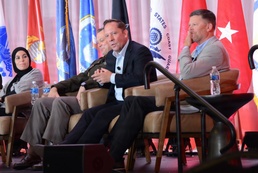
GVSETS serves as a critical forum for collaboration across the ground systems community, enabling leaders and researchers to share technical innovations, address capability gaps, and accelerate modernization. This year’s symposium featured exhibits, panel discussions, technical sessions, and extensive networking opportunities, opening with a panel comprised of top GVSC personnel that focused on how the Army is transforming through integrated experimentation.
During the discussion, GVSC Experimentation Cell Lead Tom Vern said advising industry partners how to best synchronize Army requirements, experimentation and exercises has been a top priority.
“That’s one of the biggest challenges we’ve seen—and a big part of why we’ve created the Experimentation Cell,” Vern said. “We’re able to identify what real warfighting gaps are needed to be filled and how we might fill them.”
Vern said GVSC’s focus is to bridge technologies, close gaps, and develop measures of performance and effectiveness. He said those then drive the experiment process and the work with Soldiers to collect objective data, so the next phase of collaboration and technology development moves even faster.
“By working closely with industry, it provides much better insight so you can understand exactly what the Army needs and how you want to refine your technology as you bring it back to the Soldiers,” Vern said, “especially as it moves into acquisition.”
GVSC Chief Systems Integration Officer Andrew Kerbrat echoed Vern’s emphasis on the important roles collaboration and experimentation play in advancing Army readiness.
“From an integration perspective,” Kerbrat said, “what really matters when we get to experimentation is seeing these exciting capabilities and understanding the context of how we scale them into fieldable solutions.
“That’s where early shared understanding between Soldiers, the government engineering enterprise, and our industry partners can help, allowing us to reduce risk much quicker.”
According to Kerbrat, GVSC evaluates emerging industry solutions that have the capability to fundamentally change how Soldiers fight and helps mature them for transition to acquisition—taking them from integration to interoperability. He said it’s strong partnerships that assure new capabilities are delivered to Warfighters faster.
“Those are the things I’m really excited about,” Kerbrat said. “When we get to learn early and we get to work together to identify those opportunities and get the capability to our Soldiers.”
In a separate panel comprised of several members of Detroit Arsenal’s senior leadership, GVSC Director Michael Cadieux highlighted how the Army is shaping its science and technology (S&T) investments to align directly with the future needs of the Soldier. He explained how GVSC develops a roadmap for industry partners to ensure their capabilities are not only innovative, but relevant based on key Army priorities.
“We’ve converged around five key thrust areas,” Cadieux said. “Those areas are survivability and protection, energy and power, Soldier optimization and readiness, lethality and weapons, and the fifth, which integrates all of that together, next generation maneuver formations.”
Cadieux encouraged industry partners to keep these five pillars in mind as they develop and refine their technologies, noting that this framework helps the Army identify what’s working and what isn’t, and what critical technology gaps remain. He then challenged developers to go a step further.
"When you have a capability, don't limit your thinking to its specific purpose on one system," Cadieux said. "Instead, ask how it can be leveraged for both offensive and defensive operations on that platform. Then, extend that thinking even more: how can that capability integrate with and provide value to an entire formation, from the platform itself to all echelons of a brigade combat team?"
Pointing out how GVSC is consistently working to project what needs will look like in the future, Cadieux said that thinking of capabilities in that context ensures GVSC can apply the right S&T resources to the right problems at the right times, and maximize the Army’s return on investment.
“That’s been a major shift in how we support future capabilities programs and sustainment activities,” Cadieux said. “I’ve seen a very clear prioritizing of readiness and modernization, and a significant dedication of resources when we identify opportunities to address specific challenges.
“When we pinpoint a way to solve a readiness problem, I’ve yet to find an example where we don’t commit resources.”
Ultimately, discussions and partnerships forged at symposiums like GVSETS accelerate how the Army bridges emerging technologies with current systems and operational formations. To ensure that vision becomes a reality for the Warfighter, GVSC leads technology integration by connecting research, engineering, experimentation and Soldier feedback.