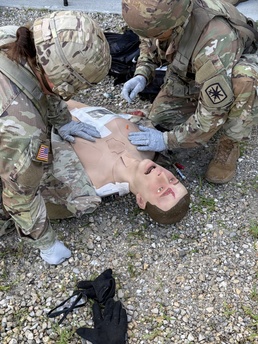
FORT LEONARD WOOD, Mo.— In the chaos of a medical crisis, a Soldier’s most profound hope is for a calm voice and a skilled pair of hands. At Fort Leonard Wood, ensuring that every combat medic specialist can be that beacon of hope is a mission that begins long before they deploy. It’s a promise forged in the classrooms and simulation labs of the General Leonard Wood Community Hospital’s Medical Education and Training Department.
This specialized team is the heart of medical readiness on the installation, working tirelessly to ensure the post’s medics are not just certified, but truly prepared to save lives under the most demanding conditions.
“Certification is the baseline of trust between a medic, their commander and the warfighter,” said Sgt. 1st Class Brian Scobee, Combat Medic Sustainment Course Coordinator. “We want to ensure that every medic is trusted, from the most senior to the most junior Soldier, to provide the best possible care in the worst possible situation.”
"When a soldier is injured, they aren't thinking about certifications; they're putting their absolute faith in the medic kneeling beside them," Scobee explained. "Our job is to make sure that faith is always rewarded. This training is the foundation of that sacred trust."
The department’s mission is to manage and facilitate the complex web of certifications every medic must maintain, from their National Registry of Emergency Medical Technicians (NREMT) certification to their Tactical Combat Casualty Care (TCCC) qualifications. They monitor expiration dates months in advance, seamlessly integrating continuing education into a medic's duties.
This constant cycle of training and validation ensures that the care provided reflects the very latest in battlefield medicine.
“Medicine, especially trauma care, is not static. What we learned five years ago has been refined by lessons learned in the field,” Scobee adds. “This continuous education isn’t about checking a box; it’s about giving our patients, our fellow soldiers, the absolute best chance of coming home.”
The training is intense and designed to build resilience and muscle memory:
Failure to maintain certification isn't an option. It means a medic is legally and operationally barred from providing care. To prevent this, instructors run medics through grueling trauma lanes that replicate the grit and stress of a real-world emergency, forcing them to apply their skills when it matters most.
"We tell our medics that the worst day of their life shouldn't be the first time they face a difficult medical situation," Scobee notes. "We create that 'worst day' here, in a controlled environment, so they can perform with confidence and competence when their unit needs them most."
By upholding these rigorous standards, the Education and Training Department ensures that every medic at Fort Leonard Wood is more than a soldier—they are a guardian, a lifesaver, and a promise kept to the warfighters and families they serve.