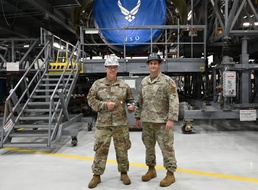
Two reserve maintainers with the 512th Maintenance Squadron created a new rigging set for the C-5M Super Galaxy aircraft engine system.
Senior Master Sgt. Chad Bryant, isochronal inspection section chief, and Master Sgt. Tyler Dickson aircraft metals technology section chief, worked together for weeks with several civilian propulsion technicians from the 436th Maintenance Squadron to custom build the new set.
The variable stator vane lever linkages rigging set includes six gauges that allow maintainers to ensure the aircraft’s F-138-GE100 engines are performing properly.
Bryant said failure of the system could cause serious issues.
“It could cause a compressor stall that may cause a lot of expensive damage and cause the engine to shut down,” said Bryant. “Most importantly, if this happens in flight, the pilot would have to shut down the corresponding engine. Being short two engines with a fully loaded aircraft is a dangerous situation for aircrew.”
The current process to adjust the VSV system in the technical order takes a team of five maintainers about 40 hours to complete, said Bryant. In addition, it can cause breakage of hardware and parts that are often hard to procure. With the new gauge, the job can be done by two maintainers over an eight-hour shift and the damage to parts and hardware is minimal.
Bryant, who is due to retire in March, said he couldn’t think of a better legacy to leave for his fellow maintainers. “It makes me feel good that I can leave this job in a better place,” he said. “Some of these jobs can make you sore with all of the working in tight spaces and having to constantly work on items located over your head.”
Bryant drew on his 32 years of aircraft maintenance to create the gauge. The current engines are roughly 12 years old and have left their warranty period. In the past, Bryant had worked extensively with the TF-39 engine that was installed on the C-5B Galaxy. There was a similar rigging set on that engine and Bryant decided to create one for the newer engines.
Bryant then collaborated with Dickson to fabricate the gauge in the base machine shop. Dickson said projects like these are one of his favorite parts of his job.
“It’s a personal satisfaction being able to help other shops increase their productivity and their ability to do their jobs,” said Dickson. “Everybody is so busy with the mission right now that any time gained back is so valuable.” The manufacturing of the gauge is a trial-and-error process, and the prototypes are being made with 7075 aluminum.
“We have an abundance of it, and it’s not expensive,” said Dickson. “If after multiple uses, we start to see fatigue, we’ll switch to something more durable and expensive like stainless steel.”
Bryant said he has been in contact with other professionals in the C-5M community, and they are eager to test out the gauge as well. He said if the testing is successful, usage of the rigging set could be implemented into the technical orders maintainers use to work on the aircraft.
Bryant added, the whole process has been fun for him; and, even with all his years of experience, he still gets a thrill from keeping aircraft in the air.
“We don’t want to hold the rest of the aircraft up from getting back out there and tackling the mission, he said. “As much of a pain it is to run into a problem, what gets my blood pumping is being able to find a solution to something that is out of the ordinary.”