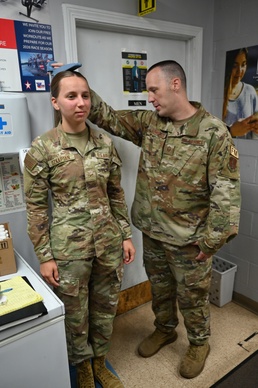
BARNES AIR NATIONAL GUARD BASE, Mass. – More than 1000 Airmen at the 104th Fighter Wing are ensuring compliance of a new Air Force body composition requirement ahead of the Aug. 31 deadline for the Guard and Reserves during their drill from Aug. 21-23 here.
Col. Michael “Shot” Glass. Commander of the 104th FW, directed the waist-to-height ratio measurements be completed during the duty day for full-time personnel and during the scheduled drill in August for traditional guardsmen, providing Airmen the chance to complete the requirement without pushing up against the cutoff date.
The new waist-to-height ratio (WHtR) is the official Department of the Air Force Body Composition Program (DAF BCP) measurement. First introduced in 2023, the WHtR differs from the previous abdominal circumference measurement, which was removed in 2020. The WHtR is not based strictly on the inches of a person’s waistline. Instead, the waistline is compared to the height.
Certified personnel measure the waist circumference in inches and divide the number by the person’s height, also in inches, to then get the measurement number. The DAF BCP outlines where the waist is located, defining the waist as “the midpoint between the lowest rib and the top of the hip bone, which is normally the narrowest portion of the abdomen”.WHtR lists two risk categories: Meeting Standard (Low-Moderate Risk): (WHtR 0.55)
The standard is now an official part of the Physical Fitness Assessment and will make up 20 percent of an Airman’s score.
Senior Master Sgt. Sean Dowd, the senior enlisted leader of the 104th FW, said ensuring the requirement should be seen as part of being ready for the mission, as opposed to Airman only addressing the task when a deadline approaches.
“If you’re wearing the uniform, you should always be ready to meet the standard, not scrambling to prepare at the last minute,” Dowd said.
Service members are expected to be in compliance but leaders such as Dowd recognize the need to support their Airmen in doing so.
“As leaders, we can’t lower the bar, but we aren’t going to let you clear it along, either,” Dowd said. “If you’re struggling, we’ll get you the resources and work through it.”
Changes in the BCP are part of a broader change in the Air Force’s physical fitness program, which earlier introduced modifications to the fitness test, to include a 2-mile run as an option instead of the previous 1.5 miles. The goal is also to provide a greater focus on overall health and readiness throughout the year, as opposed to once a year when an Airmen is due for a fitness assessment.
“We need you healthy, uninjured and lethal in the fight,” Dowd said.