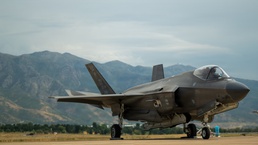
HILL AIR FORCE BASE, Utah — The 325th Fighter Wing joined the 86th Fighter Weapons Squadron at Hill Air Force Base, Utah, for an air-to-ground exercise Aug. 4-14, 2026.
Weapon System Evaluation Program-Combat Hammer 26.07 was designed to test the combat capability of air-to-ground precision-guided munitions and weapon systems of the F-35A Lightning II, while providing hands-on experience with live ordnance.
The training directly supports Air Combat Command's emphasis on readiness, lethality and Agile Combat Employment by requiring Airmen to generate combat power away from their normal operating environment while building the proficiency and repetition needed for high-end conflict.
"Combat Hammer allowed us to have hands-on exposure, specifically to air-to-ground weapons that the F-35 can carry," said Capt. Simon Little, 95th Fighter Squadron pilot. "We're able to have those weapons on the aircraft, for the first time for some pilots.”
Unlike Tyndall's primarily overwater training environment, the Utah Test and Training Range provides a different set of conditions for the F-35 and its pilots.
“At Tyndall, we don't get a ton of exposure to our air-to-ground mission set, just because we primarily train in the Gulf of America,” Little said. “So being here allows us exposure on different terrain — we get experience flying low level around the mountains and using terrain masking, different techniques and to target specific things on the ground.”
Additionally, working with live ordnance creates another layer of responsibility while providing a level of realism that can’t be fully reproduced during routine training.
"Anytime you have a live munition on the aircraft, the stress level is naturally a little higher,” Little said. “We train for this every day, but there is a distinct realism that comes with the ability to employ catastrophic ordnance … it's a sobering reminder of what we do in the F-35. We are in the business of protecting America and our values, and I think the first time you get exposure to that, it's a little bit of a sobering reminder of what we do and how we do it."
The training extended beyond the cockpit as the 325th Maintenance and Munitions Squadrons worked hand-in-hand with Hill’s WSEP team to support the 95th FS.
The 325th MUNS arrived a week before the exercise to execute a dedicated “bomb week,” assembling all the necessary ordnance from the ground up, and shifting to a rapid 24-hour cycle once the live-fly phase began.
“We are evaluated on the ability to properly build up ammunition with all the components on hand and ensuring that we start the serviceability of assets from start to finish,” said Staff Sgt. John Neer, 325th Munitions Squadron weapons system evaluation program precision-guided munitions inspector. “We get 24 hours’ notice of what [munitions] are expected for the next day, what needs to be getting greened up, finished and out to the line, so it's very quick.”
For Neer, the faster pace and smaller team structure added another layer to the exercise, forcing the team to operate with fewer personnel and resources than they normally use at home station. This shift reinforced the vital role of individual expertise and trust in a contested environment.
"Here, we're doing it as a 14-man team, as opposed to a 50-man team,” Neer said. "We brought individuals who can accomplish all the [different components] into a smaller team. So we really count on the individuals' expertise, and we have to trust that they’re doing things correctly.”
The exercise also gave newer munitions Airmen experience handling live components and working at a tempo they don’t regularly encounter at Tyndall. Neer said three members of his team had not previously built live munitions, making the exercise an opportunity to expand their experience and responsibilities.
"It’s great getting to spread the wealth and let other people learn,” said Neer. “We’re letting members take on leadership roles, even if they might be small, so they can grow in areas they've never experienced before. It's going to be incredibly rewarding to have our newer guys experience the feeling of success that comes with doing our job correctly."
The value of the exercise extended across the entire spectrum of the mission, from the Airmen assembling the bombs to the crews loading them and the pilots employing them.
"It takes an entire team to execute the fundamentals of 'fly, fight, and win' and achieve our objectives,” Little said. “Being here allows us to see how every single role contributes directly to the team's success or failure. We need everybody on the team to buy in, and we need everyone to carry their weight."
By integrating pilots, maintainers, and munitions Airmen into a single team, Combat Hammer bridged the gap between home-station training and real-world execution. Operating with live ordnance in a dynamic environment ultimately strengthens Tyndall's ability to generate combat airpower and project decisive mission readiness.