JAUNZEMI, Latvia — The drone came in low over the tree line. For a heartbeat, nothing rose to meet it.
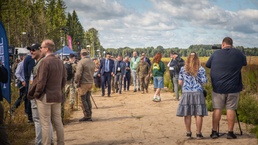
Then the counter-drone — a small interceptor built to hunt other drones — tore off the ground and was gone, a hard streak of motion that ate five hundred meters in the time it takes to breathe, running the intruder down from behind. The two dots met just above the treetops. The blast hit as light first, then as a thundercrack that rolled back across the field a half-second late, and the larger drone came apart in the air and fell to the earth while the crowd — industry engineers, senior NATO officers, Latvian troops and civilians — cheered.
It was one of the loudest things that happened all week.
The interceptor is the visible part. The hard part — the part that will actually decide whether NATO can hold its eastern edge against a sky full of cheap drones — is invisible, and most of the people who built it weren't in uniform. They were software engineers, bent over laptops in tents a few hundred meters away, and the thing they spent the week building has a name that turned out to be more literal than anyone intended.
The exercise was called Baltic Trust 2026.
“The security of the data, the compliance of the data, the trust of the data — that is something which can be complex,” said Jean Vanhay, a counter-drone software engineer with the NATO Communications and Information Agency. Then he said something that explained the week almost as well as the demonstration did: “I'm not a soldier.” He is one of the civilian engineers who have quietly become as central to modern deterrence as anyone carrying a rifle.
The problem the explosion hides
An intercept like that one looks like a win for hardware. It's really a win for information. Something had to see the incoming drone, know it was a threat and not a bird, track it precisely enough to hand the interceptor a firing solution, and do it fast enough that an attacking drone was met by the right defense — not an expensive missile fired at a decoy.
Now multiply it by a sky full of them, across a region where a single drone can cross three national borders in the time it takes to brief a commander.
“Within the model of battlefield lessons learned from Ukraine, there is a saturation of data and information that's out there,” said Maj. Paul Gromley, a British Army Royal Signals officer working with NATO's Allied Land Command on the effort at the center of the exercise — the Eastern Flank Deterrence Initiative and its data backbone. “That battle-winning edge — it didn't come down to seconds. It came down to milliseconds.”
The danger isn't any single drone — it's the math. A military can afford only so many expensive interceptors, and an adversary can build cheap attack drones by the thousands. Send enough of them, and you either run out of defenses or spend a million dollars on a missile to down a five-thousand-dollar machine. The threat comes in swarms, built to burn through an opponent's limited stock.
"There is a deliberate attempt to exhaust our exquisite capabilities, expending them on cheap Shahed drones," Gromley said. Winning means putting the right defense on the right threat, fast — "and that can only happen if it's underpinned by a network infrastructure, a data backbone that allows for the passage of data at the right speed to enable the right decision-making."
That was the week. The intercept was the demonstration. The network was the point.
Trust, built by hand
The obstacle is unglamorous and huge: NATO isn't one system but dozens, built by different nations and companies that never designed their gear to work together. Wiring each one to every other is, the engineers say, effectively impossible.
So they built a shared language instead. Many of the sensors on the range spoke an open standard called SAPIENT — Sensing for Asset Protection with Integrated Electronic Networked Technology — developed by Britain's Defence Science and Technology Laboratory and now moving through NATO's multi-year process to become an alliance-wide standard. It lets a jammer, a radar and a command system made by rival manufacturers push their information into one place. In earlier NATO trials, it linked more than 70 different systems; in some cases the connection was plug-and-play, working the instant it was plugged in.
“Normally they cannot interoperate with each other,” said Ola Timmers, a Dutch software engineer with the NATO Communications and Information Agency. “Here we connect all these sensors, these jammers, and also the command systems to this protocol so they can communicate. We're now able to do a full task lifecycle in one go” — the entire chain that had just played out over the tree line, from spotting a drone to killing it, running as one connected system instead of a scramble of incompatible parts.
Above that sits the data backbone, the effort to let those national pictures cross borders. During the week, engineers connected it to allied command applications and worked to pull a live Latvian threat picture onto systems run by Italian partners — the kind of handoff that, in a real incursion, could let one nation's radar cue another nation's defenses.
None of it works without trust in the most literal sense. A commander acting in milliseconds has to believe the track on his screen is real — an actual threat, not another nation's bad data. Vanhay's software exists largely to guarantee it. “You need to know where it's coming from,” he said. “Otherwise all the nations will receive a lot of dots on the map, and you cannot manage these things, because you cannot mitigate.”
The people in the field
The drone flew over Latvia, but the people who brought it down came from across the alliance. The officer explaining the network was British. The engineer connecting the sensors was Dutch, with other staff coming from half a dozen other nations in the alliance. The interceptor, sensors and software came from companies and organizations across the alliance, and the engineering work behind the data backbone reaches back to U.S. Army headquarters in Wiesbaden, Germany. The sensor standard came from Britain. The threat points at the Baltics; the hands working the problem came from across the alliance.
“Each one of these exercises forms a building block for greater integration,” Gromley said, “in order to solve the common problems we all face when it comes to sharing data.”
Honest about the gap
What separated the week from a polished sales pitch was that its own engineers refused to oversell it.
Asked what could actually deploy tomorrow, Vanhay didn't reach for a talking point. “If we need to deploy the system tomorrow, we will have some issues,” he said, pointing to unsolved problems moving classified data across national networks at speed. The security layer that would fix it still has to be built and tested — the work of the next exercise, not this one.
That candor is the tell that the thing is real. The intercept worked. The network behind it is real, and unfinished, and its builders will tell you both in the same breath.
By week's end the wreckage was cleared and the crowd was gone, but the point had never been the thing that burned. It was what the week was quietly proving — that the alliance is closing the seams between its members, in the open, and fast.
“With this exercise, we're sending a real message to our adversaries,” Timmers said. “We're speeding up.”
The explosion was for the crowd. The message was in the software nobody clapped for.