DES MOINES, Iowa — During the week of Aug. 10–16, 2026, Soldiers of the 103rd Sustainment Command (Expeditionary) gathered in the Des Moines area to recognize their return from deployment, reconnect as a formation and honor six Soldiers whose lives were lost.
Throughout the week, a Postvention Action Team provided grief counseling, suicide-prevention education, resources and emotional support to Soldiers at the 103rd ESC headquarters and at Norwalk High School. The school hosted the command's awards ceremony at the Norwalk Physical Education & Competition Center, where Soldiers were recognized for their accomplishments and service following their return from deployment. Norwalk High School also hosted the command's memorial ceremony on its field to honor the six fallen Soldiers.
For the formation, the week represented a complicated intersection of celebration and remembrance. Soldiers were recognizing accomplishments and returning from deployment while simultaneously confronting the loss of fellow members of their organization. The Postvention Action Team's presence provided an additional layer of support during an emotionally challenging period.
“We are the Postvention Action Team, and our main goal is to honor the service members,” said Lt. Col. Amber Taylor, a Military Equal Opportunity Advisor with the 311th Sustainment Command (Expeditionary). “But also make sure that they understand that they have support and bring them together so that they can understand why cohesion is so important.”
Postvention is an important component of suicide prevention and behavioral health support. While prevention focuses on reducing risk before a crisis occurs, postvention addresses the aftermath of a death and helps units navigate grief, trauma and the emotional effects experienced by those left behind.
This support can be especially important for Army Reserve formations. Unlike active-duty units whose Soldiers may live and work together on the same installation, Reserve Soldiers are often dispersed across states and communities. After Battle Assembly, annual training or deployment, a Soldier may return home hundreds or thousands of miles away from the teammates who understand what they experienced.
Taylor said this geographic separation makes it particularly important for Reserve Soldiers to know what resources are available and how to remain connected.
“It is very important in the Reserves,” Taylor said. “As a reservist, you're seeing more that unit members are dispersed throughout the country. So, if you don't get that help, let's say, during BA, which you might not need during BA, you're completely removed from your unit or family.”
The Postvention Action Team works to help close that distance by establishing connections before Soldiers need them.
“They've got the phone numbers, they've got that connection that, even if they're states apart, they know they can call that person,” Taylor said.
For Mr. Adam Parsley, the 103rd ESC Suicide Prevention Program Manager, postvention begins with demonstrating that Soldiers do not have to face loss alone.
“The postvention action team mobilizes, and we push our team down to the unit, and with that, it shows support from multiple commands that we care, that we're there for you, that we're with you,” Parsley said.
The team does not replace unit leadership or take control of Battle Assembly activities. Instead, it provides additional support during the memorial and grieving process.
“We don't take over the battle assembly, but we assist them with the memorial ceremony,” Parsley said. “We assist them with the grieving process of losing one of your own.”
The Postvention Action Team recognizes that every Soldier responds to loss differently. Some may openly discuss their emotions, while others may need time before they feel comfortable talking. Sadness, anger, guilt, confusion or numbness may appear immediately, while other emotions may emerge weeks or months later.
Taylor emphasized that grief does not follow a predictable timeline.
“They understand that grieving is not a one linear type of thing,” she said. “They can be okay for a long time, and then one day is not ok.”
Understanding that grief is not linear can help Soldiers recognize that difficult emotions do not mean they are failing or unable to perform their duties. Instead, grief can be part of the process of adapting to loss.
One concept presented by the team is “growing around grief.” Parsley explained that grief does not necessarily disappear. Instead, individuals learn to carry their loss while continuing to grow and live their lives.
“We go over the grief model that we use, which is growing around grief,” Parsley said. “Basically, explain to the Soldiers that the grief never truly leaves, but it's something that you grow around, and it becomes now a part of you, and who you are.”
The approach is particularly meaningful in a military environment, where Soldiers are expected to maintain readiness and continue accomplishing the mission despite personal difficulties. The objective is not to tell Soldiers to simply move on. Instead, the team helps them understand that remembering those who died and taking care of themselves can exist together.
“While at the same time, making sure they know it is still important to memorialize those they've lost,” Taylor said. “They can see how memorializing and putting a positive spin on that while also taking care of themselves is going to take care of the unit, as well, and move forward.”
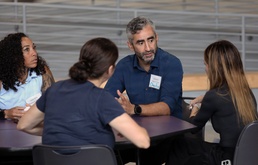
Following the memorial ceremony, the Postvention Action Team conducted small-group sessions designed to provide Soldiers with a structured environment to process their emotions. Parsley said the sessions are conducted after the memorial ceremony and lunch, when emotions surrounding the loss may still be immediate.
The groups are intentionally kept small, generally with no more than 20 participants.
One exercise, called “Into Our Tray,” uses a box containing various objects. Soldiers select an item that reminds them of one of the fallen service members and then explain the memory or emotion associated with their selection.
“What memory did it bring to you about the fallen, your one of the fallen Soldiers?” Parsley asked as he described the exercise. “That normally sparks, sometimes very positive, sometimes very angry, sometimes very emotional responses.”
The purpose is not to force Soldiers to grieve in a particular way. Instead, the exercise provides an opportunity to acknowledge emotions that may otherwise remain unspoken.
“Knowing that this is a safe place, and this is a very valid emotion, is understanding that everyone grieves in different ways,” Parsley said.
That message is particularly important after the death of a fellow Soldier. Individuals may experience anger, sadness, guilt, numbness or confusion, while positive memories can also bring moments of happiness. Providing a space where those emotions can be expressed without judgment can reduce isolation and encourage Soldiers to seek additional assistance when needed.
Although postvention occurs after a death, its purpose extends beyond memorialization. The emotional consequences of losing a fellow Soldier can increase vulnerability, particularly when individuals feel isolated, overwhelmed or unable to discuss what they are experiencing.
Taylor said the connections created through postvention can serve as an important preventive measure.
“And in doing so, that is very preventative for, um, the suicide aspect,” Taylor said. “Because we find that in moments of grief, if they weren't thinking about it before, it may be something that the grief gets so deep, if they don't have that support, if they don't know about the support or the individuals around them, they feel alone.”
That sense of isolation can become a warning sign. Establishing relationships and ensuring Soldiers know where to turn provides a protective layer during difficult periods.
Suicide prevention, therefore, is not limited to a single briefing or awareness campaign. It is built through relationships, communication, trust and a willingness to recognize when a fellow Soldier may need assistance. Counseling, peer support, chaplains, behavioral health professionals and military leaders can all provide different forms of assistance depending on an individual's needs.
“The main goal is making sure that they understand that they have resources to go to,” Taylor said. “They understand they're not by themselves.”
One challenge of suicide prevention and postvention is that success is not always immediately visible. A Soldier may participate in a discussion without speaking, or may take information about available resources without immediately reaching out.
Taylor said that does not mean the intervention failed.
“Sometimes we have some of us who don't see the immediate change in a Soldier, and we think we've failed,” she said. “But what we have to realize is we've planted a seed, and as long as we've planted that seed, it's not a failure.”
That seed may be a conversation, a phone number, a QR code containing support resources or simply the knowledge that someone is willing to listen.
“Just because we do these groups and they may not contribute right now, knowing that we have given them a QR code with a whole bunch of links to support, and they walk away with it,” Taylor said. “That is a win.”
Sometimes the Soldier reaches out later. “They may not come up to us immediately, but I've had Soldiers text me a couple days later, and it's like, that is a win,” Taylor said.
For the Postvention Action Team, success is therefore measured not only by what happens during Battle Assembly, but also by whether Soldiers leave knowing where they can turn when they need help.
“We must get used to understanding that results may not be immediate,” Taylor said. “But over a long term, just planting a seed is where we have to start.”
The 103rd ESC's memorial ceremony provided an opportunity to honor six fallen Soldiers and acknowledge the impact their deaths have had on the organization. Memorial ceremonies serve an important purpose in military culture by allowing units to recognize the service and sacrifice of their fallen comrades while giving surviving Soldiers an opportunity to grieve together.
For those who served alongside the fallen, memories may be connected to everyday experiences such as training, shared meals, missions, conversations, jokes and countless interactions between teammates. Those memories can become an important part of the grieving process.
The Postvention Action Team does not ask Soldiers to forget their fallen comrades. Instead, it helps them find ways to carry those memories while continuing to live and serve.
The team also recognizes that Soldiers may experience and express grief differently. Some may feel that discussing one loss places greater importance on that individual than another. Taylor said the team works to ensure that the process does not rank losses or determines whose grief is more significant.
Each Soldier's relationship with the fallen is different, and each individual may carry a different memory or emotional response. The team's role is to provide a framework in which those differences can coexist.
For military organizations, readiness is often measured through training, equipment, personnel and the ability to execute a mission. But Taylor emphasized that none of those things can happen without Soldiers.
“Nowadays, it seems like we're so focused on mission, which I get, that's what we do,” she said. “But without your Soldiers, you have nothing to complete the mission.”
Taking care of Soldiers is therefore not separate from readiness. It is a component of readiness.
“And if you can't get them ready, you have nothing,” Taylor said. “And ready means paying attention to the individual, and then the team, and then the mission. We're people.”
That philosophy is particularly significant for the Army Reserve, where Soldiers balance military service with civilian careers, families and communities. The strength of a Reserve formation depends heavily on relationships and the ability of leaders and teammates to recognize when someone needs help.
The week of Aug. 10–16 demonstrated that military service includes both moments of accomplishment and profound loss. The 103rd ESC recognized Soldiers returning from deployment while honoring six members of its formation who were no longer there to return. Pride could exist alongside sadness, celebration alongside remembrance, and grief alongside the responsibility to continue the mission.
The Postvention Action Team's role was not to eliminate those emotions. It was to help Soldiers understand them, talk about them and find support.
“We want to make sure that we get them not only mentally, physically, spiritually, as an individual, but as a cohesive unit as well, so they can continue to complete mission,” Taylor said.
That cohesion can become one of the most important protective factors within a military formation. When Soldiers know their teammates and leaders care, understand where to seek assistance and recognize that asking for help is not a weakness, they are better positioned to navigate difficult moments.
For the 103rd ESC, honoring its fallen while caring for those who remain demonstrated that remembering the past and preparing for the future are not competing responsibilities. Both are essential to the strength and readiness of the formation.
“The presence and them knowing that we're here, and that we care, is a success,” Taylor said.