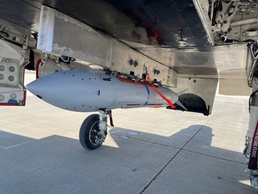
New "Partner-First" Weapon System Designed to Transform Coalition Deterrence and Interoperability
In a critical first step to modernize and secure global maritime environments, the Navy’s Precision Strike Weapons program office (PMX-201) recently awarded two contracts for the development of the Coalition Heterogeneous Affordable Offensive Strike (CHAOS) weapon system.
Managed under Program Acquisition Executive Munitions, CHAOS is designed to rapidly build and deliver low-cost, scalable precision strike weapons to allies and partners.
“As adversaries increasingly deploy advanced area denial systems, coalition and allied forces face significant challenges in maintaining credible, modern, and affordable anti-ship capabilities,” said Capt. Sarah Abbott, PMX-201 program manager.
“CHAOS closes this capability gap, by delivering a highly capable, adaptable, and exportable maritime strike solution that overcomes present day obsolescence and supply chain challenges,” she said.
Accelerated Development and Future Growth
In collaboration with CoAspire and Zone 5 — both non-traditional defense industry entrants — PMX-201 used Other Transaction Authority (OTA) to quickly execute these CHAOS contracts. OTAs provide PMX-201 powerful tools to align prototyping activities with requirements while reducing overhead to a minimum.
“These awards are the next milestone in developing an affordable maritime strike capability for security assistance partners, while expanding the defense industrial base through competition and accelerating a new entrant into the Navy’s precision-strike portfolio,” said Van Hendrey, Portfolio Acquisition Executive Munitions, who leads the new naval acquisition organization. “We saw significant demand from our international partners and worked with them to understand and incorporate their requirements from the outset. By building in exportability on day one, we are positioned to deliver an affordable warfighting capability to our partners at speed.”
A "Partner-First" Approach to Defense
Moving beyond traditional U.S. programs that prioritized domestic requirements first, PMX-201 developed a strategy for CHAOS from the outset with a “partner-first” philosophy to quickly meet international release requirements. This allows for rapid and secure technology transfer to trusted allies and partners.
“Our priority is building real, integrated capability with our allies and partners”, said Rear Adm. Ray Owens, Director of the Navy International Programs Office. “We’re working to advance interoperability, strengthen joint deterrence, and enhance fleet readiness at the speed of relevance, while remaining fully aligned with our fleet’s operational needs.”
Built entirely on Modular Open Systems Approach (MOSA) and Weapon Open System Architecture (WOSA), CHAOS is inherently adaptable. This open-architecture foundation enables rapid software and hardware updates, and the capability proposition leaves open the door to deep partnerships including co-assembly and local integration opportunities that support national industrial participation for partner nations.
The MOSA/WOSA foundation will enable an initial expeditionary ground launch capability, expected to be in production by 2028. Following this milestone, the system is set to rapidly expand to surface launch platforms, with opportunities for air-launched configurations based on warfighter demand.
Collaborative Path Forward
Through Foreign Military Sales (FMS) Cases, PMX-201 is actively inviting partner nations to participate in defining future CHAOS requirements and to explore opportunities. This collaborative strategy ensures that CHAOS remains responsive to evolving operational needs, is supportive to industry, and strengthens collective coalition deterrence for decades to come. Additionally, a continuous process of production at scale with iterative engineering is expected to yield faster, more cost-effective outcomes for the entire user community.