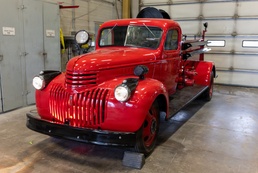
FORT LEONARD WOOD, Mo. — After a 13-year-long restoration project, an 83-year-old fire engine has a chance at a new mission due to the vision and tenacity of one local firefighter.
For more than a decade, Kevin Curtis, Fort Leonard Wood Fire Department assistant fire chief, has been working to restore a 1943 U.S. Army Class 500 Fire Truck to its former glory with assistance from the Logistics Readiness Center, the Army’s Center for Military History and Fort Leonard Wood’s Fire Department.
“Finishing a 13-year-old restoration of a 1943 fire truck is a deeply personal milestone — it’s not just about the vehicle, but about the journey, the memories and the culmination of years of dedication,” said Curtis, who is set to retire Aug. 28, 2026, after serving with Fort Leonard Wood’s Fire Department for 18 years.
The journey started in 2013 when the fire department took possession of the vintage fire engine from the U.S. Army Engineer Museum located at Fort Leonard Wood’s John B. Mahaffey Museum Complex. Curtis said the truck had been rotting in a locked yard on Fort Leonard Wood since at least 1985.
Equipped with a midship mounted 500-gallons-per-minute centrifugal or rotary gear pump, a 150-gallon water tank and 1000 feet of 2 ½-inch hose, the fire engine was designed for general-purpose firefighting at airfields, military installations and defense plants. They were also used at U.S. Army Corps of Engineers campgrounds, which was the case of the specific fire truck Curtis had his sights on, according to Troy Morgan, CMH’s Region West deputy chief.
It ended up on Fort Leonard Wood some years ago when a former director of the Army’s Engineer Museum acquired it from the U.S. Army Corps of Engineers, Morgan said.
Although the truck was not used on the installation, the old, rusted vehicle still held importance and a bit of nostalgia to the career firefighter and U.S. Air Force veteran from Lebanon, Missouri, as the make and model were among the most common fire trucks used by the U.S. Army on the homefront during World War II.
“I mentioned the fire truck to the previous Fort Leonard Wood Fire Chief Lloyd Fox, and we went out and took a look – the truck was in better shape than we thought considering the age,” he said. “Restoration was very doable – we both thought it was a great idea and a great way to pull the firefighters together as a team.”
Shortly after, fire department and museum leaders signed a memorandum of agreement, and the restoration project began with the creation of the 1943 Fire Truck Committee.
The committee’s main goal was to oversee and assist with the restoration, and to form a consensus on the outcome of the truck’s final appearance, seeking technical assistance from outside agencies and searching for antique items for outfitting the truck.
Committee members were also expected to put “some elbow grease” into helping with the restoration process, Curtis added.
“Many fire department members contributed countless hours in starting the process, and helped in finding antique equipment, parts and restoration services,” Curtis said. “Fort Leonard Wood firefighters have been having fun in the restoration process.”
In addition, LRC’s Maintenance Division volunteered to complete the body work and Morgan helped secure funding.
Michael McCain, a painter from Crocker, Missouri, who has been with LRC’s Maintenance Division for 22 years, has been with the project since the beginning.
“The members of the team that were here when we started the project, have all retired, and unfortunately, one of them passed away in April of this year,” he said. “We had a memorial plaque made with his name (James “Bill” Decker) to attach to the fire truck, since he isn’t able to see its completion.”
McCain said they were all volunteers who worked on the truck as a side job as mission allowed.
“This has been an ongoing project for 13 years,” McCain said. “Due to multiple setbacks and workload, it has taken us this long to get it near completion.”
But, for the past three months, McCain and his current teammates have been able to lock in and make “significant” progress. Their goal is to have the fire truck completed by the end of August. “It’s a relief to finally have it almost finished because it has been here (at LRC) for so long,” McCain said. “But we all feel really good and are proud about the finished product.”
Curtis and McCain agreed that 13 years is a long time, and the process has been challenging, taking longer than planned, as with many restoration projects, due to parts availability, budget constraints and personal circumstances.
“Completing the truck now is a reward for patience, resilience and passion,” Curtis said. “It’s proof that with time and care, even the most challenging projects can be brought to life.”
When complete, the Fort Leonard Wood Fire Department aims to use the vintage fire truck as an educational centerpiece.
“This fire truck is a piece of history, and we wanted to preserve history,” Curtis said. “The 1943 fire truck helps visitors understand the range of occupations and tasks on the home front that were essential to winning World War II, from firefighting to industrial support.”
Curtis said the truck is a tangible link to history and that connection can be both humbling and inspiring.
“Starting a project from scratch and seeing it complete after so many years can feel like bringing a long-lost friend back to life,” he said. “The pride is real — we’ve weathered setbacks, found parts, solved problems and made it work. Knowing you were there from the beginning gives the finished product a unique authenticity; it’s a living history we helped to restore.” More photos of the fire truck restoration project may be viewed in this https://flic.kr/s/aHBqjD2GHw.