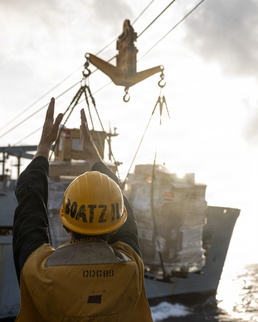
NORFOLK – In one of the most dynamic maritime environments merchant mariners have faced in decades, a small team of U.S. Navy reservists is helping commercial vessels transit the Strait of Hormuz, a critical waterway in the U.S. Central Command (CENTCOM) area of responsibility.
Supporting this effort are U.S. Navy reservists attached to Military Sealift Command (MSC), forming part of Naval Forces Central Command’s (NAVCENT) Naval Cooperation and Guidance for Shipping (NCAGS) team. These Sailors work around the clock alongside their joint, active-duty counterparts providing coordination and assistance to commercial shipping vessels.
“The most rewarding missions are those that assist mariners and preserve freedom of navigation,” said Capt. Cameron Rountree, NCAGS director. “The NCAGS team has done this consistently, particularly supporting commercial vessel transits through the Strait of Hormuz. Not since the Tanker War of the 1980s, and perhaps since the Battle of the Atlantic, has the U.S. Navy worked as closely with the commercial industry as we are now.”
Rountree, a career Surface Warfare Officer (SWO), leads a team of approximately 35 service members working to support the shipping industry during this time.
Serving alongside Rountree is Lt. Thomas Siegharter, a Strategic Sealift Officer (SSO) who was mobilized 14 months prior in support of NCAGS operations.
“I am directly responsible for maintaining maritime domain awareness in regional waters, ensuring commanders have an accurate, real-time picture of what’s happening at sea,” said Siegharter. “To put the scale of this mission into perspective, there are approximately 15,000 cargo-carrying vessels sailing throughout the Middle East on any given day; our team is responsible for aligning our focus with mission priorities.”
Siegharter recalled one particular instance where NCAGS coordination and support were essential.
“A merchant vessel was in need of support during a safety of life at sea incident,” said Siegharter. “We coordinated closely with multiple task forces, partner nations and the shipping industry to ensure the stranded crew was safely rescued which is a testament of NCAGS’ relationship with external entities, but more importantly our ability to assist civilian mariners.”
A U.S. Merchant Marine Academy graduate, Siegharter also noted the value reserve Sailors bring to the multifaceted missions of MSC.
“When it comes to how the MSC reserve force maintains the Navy’s warfighting edge, I believe there are three areas: rapid scalability, extraordinary professional expertise and an incredibly high level of personal motivation,” said Siegharter. “There are an incredible number of opportunities and missions with MSC to explore and support. Serving in this dynamic environment connects me directly to the proud, continued heritage and deep-rooted traditions of both the U.S. Navy and the Merchant Mariners who came before us.”
With over 900 Selected Reserve and Individual Ready Reserve Sailors to call upon, MSC holds one of the Navy’s largest reserve commands.
“MSC sails the globe and operates in ports and airspace that many service members never encounter,” said Rountree. “MSC employs combat logistics force ships, aircraft, chartered vessels, and unique-mission craft to service the responsibilities it owes to Fleet Commanders, U.S. Fleet Forces Command, and U.S. Transportation Command. When I ponder MSC’s vast mission-set, I am proud to be a part of it.”
MSC exists to support the joint warfighter across the full spectrum of military operations, with a workforce that includes approximately 6,000 Civil Service Mariners and 1,500 contract mariners, supported by 1,500 shore staff and 3,500 active duty and reserve military personnel.
Follow the link to learn more about MSC at: https://sealiftcommand.com/.