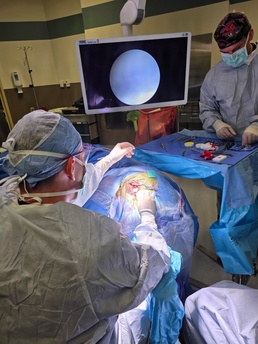
JOINT BASE SAN ANTONIO, Texas, August 19, 2026 -- For military families stationed at Joint Base Elmendorf-Richardson, Alaska, the geographic isolation of the "Last Frontier" can present unique medical logistical challenges.
Historically, when a service member or dependent required highly specialized surgical care, the standard protocol involved sending the patient Temporary Duty (TDY) thousands of miles away to larger military medical treatment facilities, such as those in San Antonio, Texas.
Today, a highly efficient approach known as the "circuit-rider" model is flipping that paradigm by bringing the specialist directly to the patient. Recently, JBER used the circuit-rider model to address a localized need for complex otologic (ear) surgeries using the skills of Air Force Maj. (Dr.) Jason Adams, staff neurotologist, Brooke Army Medical Center.
By deploying sub-specialist surgeons to travel between multiple clinics and hospitals, the military can provide world-class specialty care closer to home while maximizing the impact of limited medical personnel.
Complex Care in the Last Frontier “Operating at a major trauma and research center like BAMC builds a foundation in complex, high-acuity skull base pathology,” Adams said. “When transitioning to a "circuit rider" role at JBER, this highly specialized skill set translates into enhanced capabilities for broader head and neck procedures. Expert knowledge of surgical anatomy and resource management are key in performing safe surgery while navigating certain limitations inherent in transitioning from a tertiary academic center to a secondary care center, for instance recognizing and planning for the absence of neurosurgery and neurosurgical critical care services.”
Maj. (Dr.) Khang N. Lu, staff otolaryngologist and medical director for JBER's Department of Otolaryngology, highlighted the difficulty of relying solely on the local civilian network for these specific needs.
"Alaska also only has one neurotologist in the community, so it does take a while to refer out to him," Lu explained.
“By coordinating a visit from Dr. Adams, we were able to schedule multiple intricate procedures locally. The surgical docket included a pediatric tympanoplasty to repair a hole in a child’s eardrum, as well as a highly complex procedure to remove a non-cancerous skin growth (cholesteatoma)from behind the eardrum andrebuild the tiny, damaged hearing bonesinside the ear.”
Lu added that the ability to bring that level of specialty care to the local MTF doesn’t just benefit patients in the operating room – it also has a direct impact on readiness and resources across the installation.
"The patient can also recover at home and be back to duty within 1-2 weeks instead of being sent TDY to San Antonio," Lu noted. "This saves money and time for the military. We also keep the work and services within our own health care system."
Maintaining their skillset Beyond the immediate benefits to patient recovery and resource management, the circuit-rider model serves as a critical training multiplier for the local medical staff. Because JBER's patient population is relatively small, local surgeons and operating room teams rarely encounter these highly specific cases.
"Having the procedures done at JBER will help refresh my surgical skills for these types of cases,” Lu said. “The goal is to be able to independently do these cases myself after the neurotologist leaves." This hands-on mentorship extends to the entire surgical team. Lu said the visiting specialist helps keep local nurses and technicians’ skills sharp for neuro-otologic procedures, noting that even technical steps such as properly setting up the microscope can be complex and easy to forget.
A Strategic Model for the Future While extremely urgent cases—such as head and neck cancers—will continue to require immediate referrals outside the facility rather than waiting for a visiting surgeon, the circuit-rider concept shows immense strategic promise for complex, non-urgent subspecialty care. Dr. Lu advocates for grouping these cases to align with short circuit-rider TDYs. This practice centralizes patient documentation within the military's electronic medical record system, decreases the burden on limited community specialists, and saves significant funds by keeping referrals internal.
JBER Director Col. Angela Lacek agrees.
"By bringing sub-specialists directly to JBER, we not only keep our local surgical teams and hospital staff medically ready through hands-on mentorship, but we also ensure our patients receive world-class care locally, allowing them to recover at home and return to duty faster," Lacek stated. "Expanding this highly efficient model across the Military Health System is a win-win that fights local skill atrophy, saves vital resources, and significantly enhances overall force readiness."