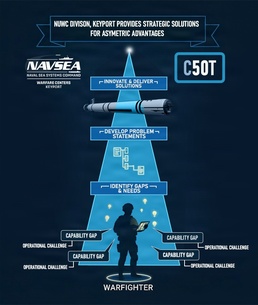
The Technology Office within Naval Undersea Warfare Center Division, Keyport’s Unmanned and Theater Undersea Warfare Systems Department, Code 50, is accelerating how the Navy develops and deploys new capabilities.
“We're trying to help bridge the gap between identifying, maturing and transitioning disruptive undersea technologies, and really seeking to operationalize capabilities,” said Danny Hubert, acting deputy chief technology officer. “We’re ensuring that we can transition these [technologies] to the Fleet so that [they] can maintain that asymmetric advantage specifically within the subsea and seabed warfare domain.”
The office has a specialized team to manage this complex pipeline. The team, which includes capability managers who oversee specific research areas, alongside a group of scientists led by Chief Scientist Dr. Mark Paulus, is focused on fielding early-stage technologies in active water environments.
Rather than relying on top-down directives, the office, known as 50T, uses a bottom-up approach driven by real-world operational gaps. These gaps are identified by representatives embedded within combatant commands, who then create problem statements for which subject matter experts pitch solutions.
According to Daniel Gentile, a computer engineer who conducts research and development for 50T, this ensures that all research directly addresses a tangible need for the warfighter, while giving researchers the freedom to innovate and choose the best possible methods, materials and designs.
“It reminds me of the TV show ‘Shark Tank,’ where you show up with your presentation on your solutions, and you say why you think yours should be funded, and then they select projects out of that list to allocate funding to,” said Gentile.
The team designs problem statements around common underlying needs, so that technologies developed for one specific application can quickly be adapted to benefit others. This prevents technologies from remaining siloed within the command and encourages researchers to build with the broader Navy in mind.
“Problem statements are crafted to help us leverage the research that's being done in one area to benefit other research areas,” said Hubert. “So a benefit and growth in one area transfers to the others, either directly or with minimal change.”
One of 50T’s main research areas involves evaluating novel technologies such as advanced acoustic sensors and underwater communication systems. NUWC Division, Keyport’s robust testing infrastructure—which includes acoustic test facilities and local water ranges—is vital for testing these technologies.
The office is also working to establish an unmanned undersea vehicle proving ground to provide industry and academic partners with a dedicated space to validate their systems, according to Hubert.
50T manages projects funded through various pipelines, including the Naval Innovative Science and Engineering program and Work for Private Party agreements. WPP agreements allow the command to act in a role similar to a contractor, designing custom scientific instrumentation for external partners.
Through a recent WPP agreement, 50T designed custom data recorders for the University of California, San Diego to track whale migrations. Gentile, who designed the hardware, said he was thrilled when the team later received footage of those same recorders being used in a tank at an area marine park to capture the vocalizations of a beluga whale.
50T’s collaborative approach to developing and operationalizing undersea technologies directly supports the second and fourth Naval Sea Systems Command Enterprise Lines of Effort, “Generate Readiness” and “Strengthen the Navy Team.”
-KPT-
Naval Undersea Warfare Center Division, Keyport is headquartered in the state of Washington on the Puget Sound, about 10 miles west of Seattle. To provide ready support to Fleet operational forces at all major Navy homeports in the Pacific, NUWC Division, Keyport maintains detachments in San Diego, California and Honolulu, Hawaii, and remote operating sites in Guam; Japan; Hawthorne, Nevada; and Portsmouth, Virginia. At NUWC Division, Keyport, our diverse and highly skilled team of engineers, scientists, technicians, administrative professionals and industrial craftsmen work tirelessly to develop, maintain and sustain undersea warfare superiority for the United States.