Behind every aircraft crossing international airspace, service member operating on foreign soil and mission conducted alongside an Ally or partner is a network of agreements defining how U.S. forces can operate.
For the legal professionals at U.S. Air Forces in Europe – Air Forces Africa, strengthening that network often means working early with foreign partners to agree on authorities, rules, and processes that help us get the job done.
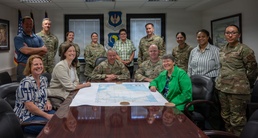
That work recently earned the USAFE-AFAFRICA Office of the Staff Judge Advocate the Secretary of the Air Force General Counsel Award for Dispute Resolution, recognizing the team's efforts in negotiation and dispute resolution across the European theater.
"The Judge Advocate is here to protect the command and create space for them to accomplish their mission," said Leslie Schmidt, USAFE-AFAFRICA JA international law attorney. "When we're negotiating, we're working with other countries to get the space, the supplies and the permissions that we need to operate our aircraft and to maintain our force."
The team's work spans an increasingly complex operating environment where U.S. forces routinely work alongside Allies and partners under agreements developed over decades.
Among the efforts recognized were the development of implementing arrangement templates supporting defense cooperation agreements with NATO Allies. These arrangements take broader international agreements and translate them into the practical details necessary for forces to operate together — from environmental considerations to access, logistics and other requirements.
The work has become particularly important as NATO has expanded, including the accession of Finland and Sweden in recent years.
While defense cooperation agreements establish broad commitments between nations, implementing arrangements help define how those commitments work in practice.
"They're the actual nuts and bolts of how we're going to cooperate," Schmidt said.
One example involved developing an environmental implementation arrangement template designed to respect host-nation environmental requirements while ensuring U.S. forces remain compliant with U.S. environmental policies and authorities.
The office also helped establish a new bilateral forum with the United Kingdom designed to address potential areas of friction before they affect operations.
The United States and United Kingdom have operated alongside one another for generations, but the longevity and depth of that relationship also mean the two nations operate under a collection of agreements and arrangements developed at different times and levels.
The Bilateral Defence Forum brings senior decision-makers together twice a year with a planned agenda to identify concerns, clarify agreements and work through issues before they interfere with the mission.
"We're setting up a process to identify issues and discuss options for resolution before they become major problems," Schmidt said.
That emphasis on communication is central to the team's approach.
Rather than waiting until disagreements require formal resolution, USAFE-AFAFRICA legal professionals work with Allies, partners and organizations throughout the command to establish shared understanding early.
"Negotiation and dispute resolution are essentially communication," Schmidt said. "This involves talking up, sideways and down to ensure the products we negotiate support and advance USAFE-AFAFRICA’s mission."
The team also supported data-sharing efforts with European Allies and partners, helping improve the common operating picture available to U.S. and Allied forces. Sharing information can reduce duplication of effort while providing commanders with information needed to plan and execute missions.
Those negotiations rarely involve attorneys working alone.
Legal professionals regularly rely on subject-matter experts throughout the Air Force and joint community to understand the operational and technical details behind the agreements they negotiate.
"We are experts in legal problem solving," Schmidt said. "We are not subject matter experts on the technical details in our negotiations."
Depending on the issue, that can mean working with environmental specialists, security professionals, customs experts or representatives from other military services. That collaboration helps ensure agreements are not only legally sound but accomplish what commanders and operators need them to do.
The office also works to resolve issues at the lowest appropriate level whenever possible using interest based techniques, preventing problems from consuming additional resources across higher headquarters.
"Every step up a command that a problem has to go is another staff that has to get read onto it, that has to get spun up, that has to brief their commander," Schmidt said. Resolving an issue early reduces the people, time and resources required to address it.
Operating across Europe adds another layer of complexity.
Successful negotiation, Schmidt said, requires understanding not only U.S. objectives but the concerns and perspectives of host nations and partners.
"The biggest challenge in all of these is putting yourself in the shoes of the partner," Schmidt said. "Finding your common goals to protect U.S. security interests rather than getting hung up on the differences."
For USAFE-AFAFRICA, those common goals center on maintaining peace and security and sharing responsibility for the defense of Europe.
The legal team's work also includes protecting the rights of U.S. personnel overseas. Under the NATO Status of Forces Agreement and other international agreements, criminal jurisdiction can involve both U.S. and host-nation authorities. The team worked to secure the release of foreign criminal jurisdiction in 21 complex cases, helping protect service members' due process rights while reinforcing U.S. responsibility for the conduct and discipline of its forces.
The breadth of the mission requires experience, collaboration and an understanding of how issues in one country can inform negotiations in another.
Schmidt credited the office's success to the depth and diversity of experience across the team, including senior attorneys whose careers have exposed them to legal and operational challenges throughout Europe.
"We are just stacked with talent," Schmidt said. "That diversity of experience, that competence and those leadership skills, I think are tremendous assets to what we do here."
For Airmen outside the legal community, much of that work may be invisible.
Courtrooms and litigation are often the most recognizable aspects of military law, but much of the work performed by judge advocates happens long before an issue reaches that point.
"Most JAGs are not in court on a regular basis," Schmidt said. "A huge part of being a lawyer is making sure that the command meets our legal obligations. My office is focused on meeting our obligations under international law. And the purpose of those regulations and of international law is to prevent conflict in the first place."
That work is particularly important for an Air Force whose ability to accomplish its mission depends on access and movement.
"The Air Force is inherently a mobile organization," Schmidt said. "We are not the Air Force if we are not moving through the air."
Securing the rights necessary for Airmen and aircraft to move through allied and partner nations, operate from their territory and accomplish missions is therefore directly connected to USAFE-AFAFRICA's ability to generate airpower.
For the team, the Department of the Air Force-level recognition came as a surprise. Many members did not know the office had been nominated for the award.
But Schmidt said the recognition comes at an important time for the command and its relationships throughout Europe.
"We are at a moment in Europe right now ... where our partnerships are more important than ever," Schmidt said. "We have a uniquely talented team, a uniquely qualified team that is supported by the leadership here to execute."
For USAFE-AFAFRICA's legal professionals, that execution often happens quietly — through a conversation, an agreement or a problem solved before it jeopardizes the command’s mission.
The result is greater freedom for commanders to make decisions, stronger relationships with allies and partners, and the legal foundation necessary for Airmen to accomplish the mission across Europe and Africa.