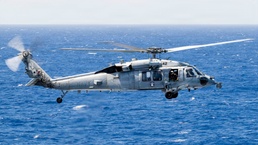
PORTFOLIO ACQUISITION EXECUTIVE AVIATION, PATUXENT RIVER, Md. — In a critical step to ensure long-term fleet readiness and secure dominance in the maritime domain, the Navy’s MH-60 service life modernization program recently announced the industry performers identified to proceed to the first phase of a Statement of Work (SOW) collaboration for the MH-60 Tailorable Architecture Leveraging Open-systems (TALON™) prototype project.
Led by the H-60 Multi-Mission Helicopter program office (PMA-299), in a joint cooperative effort with the Royal Australian Navy, TALON will simultaneously modernize the MH-60 avionics and mission system architecture while resolving multiple obsolescence issues.
TALON is designed to deliver a cost-effective platform that can rapidly respond to emerging threats, adapt to new fleet requirements, and support MH-60 sustainment through the 2050 timeframe. Through collaborative digital engineering and open-system design, this joint effort strengthens the ability of U.S. and allied maritime forces to outpace emerging global threats for decades to come.
To execute this modernization strategy, the government is using an Other Transaction Authority (OTA) agreement facilitated by the Naval Aviation Systems Consortium (NASC) to engage industry partners across three critical roles:
Lead Aircraft Integrator (LAI): Sierra Nevada Corp. was identified to design the physical and structural integration for the MH-60S (Sierra) variant. Lockheed Martin Rotary and Mission Systems (LM RMS) was identified to design the physical and structural integration for the MH-60R (Romeo) variant.
Segment Lead Integrator – Flight Critical Avionics Segment (FCAS) (SLI-F): Rockwell Collins Inc. and LM RMS were identified as the SLI-F responsible for hardware and software architecture design, interface management, and system-level software integration for the FCAS and Digital Backbone (DBB).
Open System Verification Demonstration Third-Party Integrator (O3PI): Technology Security Associates Inc. was identified to support the government's assessment of how segment integrators implement Modular Open Systems Approach (MOSA) in the FCAS and DBB system, to include OSVDs.
This does not constitute formal contract or agreement awards, which remain contingent upon successful negotiation and finalization of the Phase 1 SOWs, laying the groundwork for a major leap in naval aviation technology and marking a critical step toward potential prototype development for FCAS and DBB.
Under this phased acquisition approach, Phase 1 will focus on preliminary FCAS and DBB design, establishment of the collaborative digital engineering environment (DEE) and characterizing the baseline aircraft, which involves physical integration, structural modification, A-kit fabrication, and preparation for aircraft-level testing. Phase 2 will focus on prototype development and verification activities.
By utilizing modern digital acquisition practices and MOSA standards, TALON will support MH-60 key business drivers while also streamlining Future Vertical Lift (Maritime Strike) (FVL(MS)) development with a core open architecture that is portable.
The MH-60R specializes in anti-submarine warfare, surface warfare, electronic warfare, and command and control. The MH-60S is used for performing anti-surface warfare, combat search and rescue, special warfare support and airborne mine countermeasures.