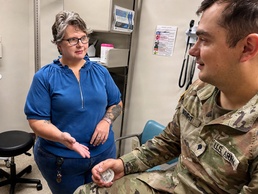
FORT POLK, La. — Quitting nicotine isn't just about throwing away a pack of cigarettes or a vape; it’s about reclaiming your health, your money, and your mission readiness. For Soldiers and Families stationed at Fort Polk, Bayne-Jones Army Community Hospital offers a customized tactical roadmap to help you break free from tobacco and nicotine for good.
The tobacco and nicotine cessation program combines counseling, education and clinical support for those who want to quit smoking, vaping, dipping or using other nicotine products.
Through the Department of Public Health, Health Promotion Technicians Cheryl Ross and Asia Sampson provide education and counseling, helping patients understand nicotine dependence, identify triggers and develop a realistic plan for quitting. When medication or nicotine replacement therapy is requested or may be appropriate, Nurse Practitioner April Draper Davis provides clinical evaluation and support.
“The first thing we want our patients to know is that we are not here to lecture them or tell them what they must do,” Ross said. “We start by getting to know them and their nicotine use.”
During the first appointment, patients learn how nicotine addiction works, what cravings and withdrawal can look like, and what resources are available. The conversation then turns to their own nicotine use, previous attempts to quit and situations that may trigger cravings.
Sampson uses motivational interviewing — a counseling approach that helps patients explore their own reasons for change — along with SMART goals — specific, measurable, achievable, relevant and time-bound — to create a personalized quit plan.
“I don’t just hand them a plan; we build it side-by-side, so it fits their lifestyle, their mission and what matters most to them,” Sampson said.
Counseling continues after the initial appointment, allowing the team to evaluate progress and adjust when necessary.
“If they slip or relapse, we treat it as data, not failure, and revise the roadmap instead of starting from scratch,” Sampson said.
For patients who may benefit from medication or nicotine replacement therapy, Draper Davis assesses their individual medical needs and determines appropriate treatment options.
“As with any encounter, it’s individualized treatment,” Draper Davis said.
Depending on a patient’s medical needs, options may include prescription cessation medications and nicotine replacement products such as patches, gum or lozenges. Draper Davis said these tools can help reduce cravings and make them more manageable while patients address the habits and routines associated with nicotine use.
The approach isn’t limited to cigarettes. Vapes, smokeless tobacco and nicotine pouches also contain nicotine and can be addressed through the cessation program.
“Those products all contain nicotine,” Draper Davis said. “The medications work on the nicotine aspect of it, not just the typical tobacco.”
Draper Davis also assesses whether a patient is ready to quit. Stress, previous attempts and other lifestyle changes can affect the likelihood of success, making the timing and approach different for each patient.
The cessation team encourages BJACH providers to make nicotine use part of routine patient conversations and connect those interested in quitting with Public Health.
“A simple question about whether a patient uses nicotine, followed by encouragement and a referral to our program, can have a real impact,” Ross said.
Patients can talk with their primary care provider about a referral or contact the Department of Public Health to learn more about tobacco and nicotine cessation services.
“We want them to leave that first visit feeling like they have a realistic plan and somebody in their corner,” Ross said.
For more information, contact the BJACH Department of Public Health at 726-780-1149.