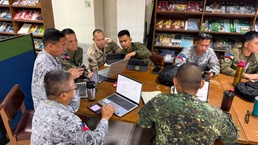
CAMP AGUINALDO, Quezon City, Philippines — Marking a landmark decade of bilateral cooperation, senior military officers from the Armed Forces of the Philippines (AFP) and six partner nations completed the 10th-anniversary iteration of a collaborative disaster response training curriculum at Camp Emilio Aguinaldo, Quezon City, from August 4 to 6, 2026.
This milestone training celebrates an educational partnership that began in 2016 when the U.S. Pacific Command’s Center for Excellence in Disaster Management and Humanitarian Assistance (CFE-DM) first worked with the AFP Command and General Staff College (CGSC) to integrate a dedicated Humanitarian Assistance and Disaster Response (HADR) module into the course’s curriculum.
"We are proud of this ten-year partnership with the Armed Forces of the Philippines Command and General Staff College," said CFE-DM Deputy Director Steve Castonguay. "The Philippines is a nation prone to natural disasters, and their armed forces are regularly called upon to lead frontline response efforts. This disaster response course is essential in preparing senior AFP leaders to integrate seamlessly with the international community and civilian humanitarian actors during emergency operations."
Over the last ten years, this joint initiative has focused on increasing AFP disaster response capabilities by educating senior field-grade officers—the future commanders and staff planners who will lead operations on the ground during regional crises.
The August 2026 course brought together 204 senior field-grade officers including 192 Philippine officers alongside 12 international students representing Indonesia, Malaysia, Australia, the Republic of Korea, Thailand, and Cambodia.
The course was co-facilitated by a specialized instructor team from CFE-DM and incorporated guest instruction from regional civilian partners, including the United Nations Office for the Coordination of Humanitarian Affairs (UNOCHA) Philippines and the UN World Food Programme (WFP) Philippines.
Throughout the three-day training, students analyzed the complex international frameworks, norms, and coordination mechanisms used by assisting state militaries and civilian aid organizations. Practical application exercises formed the core of the curriculum.
One scenario involved students working as the staff of the AFP Northern Luzon Command where they drafted operational plans and courses of action to address a simulated Category 5 typhoon making landfall in Northern Luzon combined with a concurrent volcanic eruption of Mt. Pinatubo in Central Luzon.
Developing a unified understanding of civil-military coordination before an emergency occurs is critical to ensuring that military assets are integrated effectively to support local and international relief efforts. By celebrating a decade of educational integration, the United States and the Philippines continue to demonstrate how long-term bilateral investments in senior leader education build regional self-reliance, deepen alliance interoperability, and ensure that joint forces stand ready to save lives and alleviate human suffering.