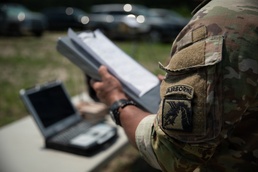
FORT BRAGG, N.C. — More than 50 companies gathered at the Lt. Gen. James M. Gavin Joint Innovation Outpost Aug. 11-13 to build a layered, integrated defense against unmanned aircraft systems, or UAS, as part of the Counter-UAS Integration and Planning Conference, ahead of Scarlet Dragon, in September 2026.
The conference, hosted by XVIII Airborne Corps, brought together sensor manufacturers, command-and-control developers, communications providers and common operating picture businesses to evaluate how their systems perform both individually and together as part of the Corps' broader defensive fires mission.
"What we wanted to look for is their capability to perform individually, as well as with each other between all of the industry partners, to provide us this capability in the future, not only for the base, but also in tactical situations," said Maj. Anne Pham, deputy director for XVIII Airborne Corps G34 Fires and Effects. Pham, an officer with the Royal Canadian Artillery, represents the allied integration built into how the Corps approaches its warfighting mission.
Industry partners also traveled to the Fayetteville area for individual sensor evaluation, testing each system against representative unmanned aircraft threats. Staff Sgt. Jacob Schmall, assigned to G34 Fires, XVIII Airborne Corps, said the evaluation is designed to determine what each sensor can detect, track and characterize.
"The goal isn't to find one system that does everything," Schmall said. "It's to understand how different capabilities work together and integrate the best technologies into a more complete counter-UAS architecture." No single sensor can address the full range of unmanned aircraft threats, Schmall said. Each technology brings different strengths and contributes different information to the broader picture.
"This evaluation helps us understand what each sensor contributes and how these capabilities complement one another," Schmall said. "Ultimately, the goal is to combine that information into a more accurate, timely and usable airspace picture for both commanders and operators."
Together, the conference and the sensor evaluation feed directly into Scarlet Dragon, an XVIII Airborne Corps exercise that evaluates new technology across the force, including the counter-UAS capabilities.