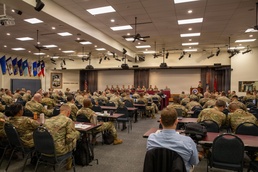
CAMP ROBINSON, Ark. — Army National Guard leaders from across the force gathered at the Professional Education Center this week for the Collective Training Seminar, where they are coordinating major training events, addressing resourcing challenges and shaping collective training plans through fiscal year 2031. Representatives of The National Guard Bureau, Army training commands such as First Army, and other organizations across the 54 that serve the mission of planning and supporting the collective training of the guard come together at The Collective Training Seminar (CTS) to prepare for large scale training exercises years before soldiers will ever come up against them in the field. Participants review hard lessons learned from the previous year's rotational training units, refining training plans for fiscal years 2027 through 2029 and beginning coordination for fiscal years 2030 and 2031. They also begin the arduous task of identifying training friction points and hang ups before working to resolve them before they can hinder the readiness of future participating units. Competing requirements, resource limitations, conflicting schedules, and support gaps become quite difficult to manage and resolve once a unit is coming up on a large scale exercise, and nearly impossible once it has already begun. These are just a few of the friction points attendees set out to identify and solve. Something as simple as equipment, transportation or training space not being available during the window a formation needs can disrupt other parts of the exercise and limit what soldiers are able to accomplish while they are there. By bringing together the minds responsible for mitigating these factors, the CTS gives senior leadership an opportunity to work through needed adjustments in real time to ensure that our soldiers receive the highest quality of training possible. This also provides leadership from the 54 to share and discuss recent lessons learned by trial and sweat through their organization's own rotations through these training events. Those experiences can help other formations avoid repeat problems, refine their own plans and make better use of limited training time and resources. Holding these discussions at PEC serves its mission in bringing together leaders from across the Guard to address training and readiness challenges that extend well beyond a single state or organization. The solutions developed here can and will influence how formations across the force prepare for training years into the future. For large scale training events to be successful, there are several moving pieces such as space, equipment, manning, transportation and mission support, that all need to fit together at the right time in the right place. When any piece of this equation is missing, rippling effects can be felt throughout the training and have a negative impact on our soldiers ability to learn and apply the needed tools to support and defend their community and their nation. The effect carries forward. Better planned training gives soldiers and formations a better opportunity to meet training objectives, which produces units that are better prepared when the Army needs them for an overseas mission or when their communities need them at home. Resolving problems years before a rotation can therefore reduce risk long after the training event itself is complete. It is these such instances where the impact of the CTS becomes most visible. For the Army National Guard, better synchronization means units have a stronger chance of arriving at major training events prepared to train at the level expected of them. It also helps ensure those formations are ready when called to support combatant commanders overseas or respond to emergencies at home. Although many of the events being discussed at PEC are still years away, the decisions being made now will shape how those units train when their turn comes. Readiness begins not at the last minute, but in every minute before, and in many cases, it begins with conversations like these.