HUNTER ARMY AIRFIELD, Ga., — A rogue civilian drone drifts over Hunter Army Airfield, a secure military flight line, its whirring rotors freezing emergency air traffic. Minutes tick by. On standby, a Coast Guard helicopter crew waits to launch a critical life-saving rescue mission, grounded by an invisible, unauthorized threat in the sky.
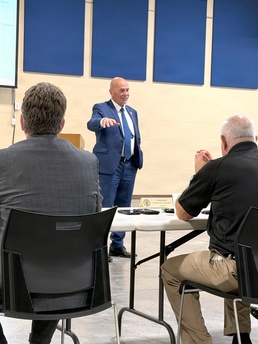
This high-stakes scenario is one provided by Special Agent in Charge Ryan O’Connor, Department of the Army Criminal Investigation Division, Southeast Field Office. He highlighted the need for cross-sector communication which was the goal of the Law Enforcement/Legal breakfast hosted by Army CID, Aug. 6 at Hunter Army Airfield.
“We were hosting a collaborative, law-enforcement and legal community liaison event as an effort to deconflict either operational things or identify challenges that state, local, and federal agencies are facing, whether it's manpower or capabilities that maybe another agency can augment,” said O’Connor.
The morning brought together leaders from local law-enforcement offices, federal agencies, and military installations. The shared goal was simple: build personal rapport before a crisis forces the issue.
“The importance in having collaboration between all the different law-enforcement agencies and the United States Army here at Fort Stewart and Hunter Army Airfield, is that no one law-enforcement agency can do anything on their own,” said Thomas Kilbride, U.S. Marshal for the Southern District of Georgia. “But by us meeting each other face-to-face, the collaboration becomes tremendous. And everybody has different resources so it’s much more effective that you have a personal relationship with the leaders of each of the these organizations. Going forward these relationships are only going to improve.”
The event opened with a short presentation by the U.S. Marshals as well as the Bureau of Alcohol, Tobacco, Firearms and Explosives’ Search Enhanced Evidence K9 program. Then each participant introduced themselves and explained their role and responsibilities. Many organizations shared concerns over manpower vacancies and their hope that through working together, they would be able to fill the gaps.
“The human interaction, especially in the law-enforcement community, is critical,” said O’Connor. “A lot of things in the law-enforcement community don't happen on schedules. At times of crisis (…) that’s a time when you just need the community to surge and respond, so being able to have that personal connection is critical.”
This was the third iteration of the breakfast and O’Connor said he hopes to continue to increase participation with each event.
“We’re just interested in growing it at this point and getting more of our local law-enforcement partners here,” said O’Connor. “It’s important that as a law-enforcement community we support each other to create a safe environment not just for our military but the citizens and residents in and around Chatham country and Savannah.”