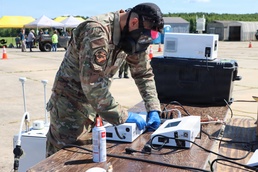
The U.S. Army Combat Capabilities Development Command Chemical Biological Center (DEVCOM CBC) hosted a field experiment July 21-25 to put emerging environmental air monitoring technologies directly into the hands of warfighters for evaluation.
The Defense Threat Reduction Agency (DTRA) Joint Science and Technology Office (JSTO) sponsored the field experiment event, known as the Micro-S&T CBRN-Capability Operational User Trial (Micro-SCOUT). The field experiment was designed to support strategic goals to shorten acquisition timelines, prioritizing rapid technology delivery and immediate battlefield utility.
One primary area of focus at Micro-SCOUT was evaluating available commercial off-the shelf (COTS) environmental air samplers and bio-detectors for warfighters. To ensure this equipment does not fail when needed the most, it is essential to put it directly into the hands of those operating on the front lines and conduct Early User Assessments (EUA) and Technical Evaluations (TE), key components to the recent field experiment. When warfighters push these commercial and emerging technologies to their limits during an EUA, they can quickly validate the equipment's effectiveness—ensuring it is ready to maintain operational readiness abroad and protect public health at home.
“We need technology in the field that makes sense and helps us move faster,” said U.S. Air Force Staff Sgt. Briza Dykstra. “The gear we tested is quicker and lighter. If a tool isn’t practical for the warfighter, it’s just a hurdle.”
Micro-SCOUT put this feedback into action by letting warfighters get hands-on experience with next-generation environmental air samplers and bio detectors. Personnel had the unique opportunity to learn, observe, and actively test these critical systems in real-world scenarios. The feedback gathered during these evaluations allows engineers and developers to modify, upgrade, and reinforce these commercial capabilities to meet the precise, highly demanding operational requirements of the warfighter.
Earlier this month, the Center stood up the Chemical Biological (CB) Foundry Battle Lab, an innovative and collaborative space designed to rapidly integrate, assess, and accelerate the fielding of capabilities in support of the chemical biological defense program. The recent Micro-SCOUT field experiment was held in both the indoor CB Foundry Battle Lab as well as on the ranges, offering warfighters with a unique opportunity for training on the operation of the COTS systems and the ability to assess the form, fit, function, and relevance. During the event, U.S. Air Force Staff Sgt. Samuel Baker learned about the new systems. "It’s great to know this technology can collect, detect, and categorize it for us—that is where the value proposition is," said Baker.
Joshua Schulte, a computer engineer at DEVCOM CBC, observed firsthand how quickly the participants adapted to the systems. "We definitely saw the warfighters' lightbulbs come on with the tech," Schulte said. "We had a very imaginative group who were quick learners. The training phase got a lot of good feedback but actually having them operate the equipment in the field really made things click for them.”
The collaborative environment created a direct line of communication between warfighters and the development team. "This is a great event," said U.S. Air Force Staff Sgt. Charles Brousseau. "It allows us to provide feedback, ask questions, and add suggestions... [for] subject matter experts and DEVCOM CBC scientists."
The Center remains committed to protecting the warfighters from evolving threats and equipping them with advanced technologies that support the mission. Schulte added, “This event is just another step forward. It is incredibly rewarding to take this valuable feedback and immediately apply it to make these critical systems even more effective.”