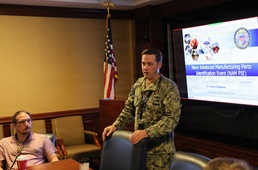
NORFOLK, Va. — Commander Navy Regional Maintenance Center (CNRMC) kicked off the two-week Navy Advanced Manufacturing Parts Identification Event (NAMPIE) July 13, 2026, at Shore Intermediate Maintenance Activity (SIMA) Norfolk. The event was a collaboration between fleet maintainers, engineers and manufacturing experts, identifying new opportunities to reduce repair timelines, improve training, and accelerate the delivery of mission-critical parts to the Fleet.
Advanced manufacturing refers to innovative technologies which fabricate, repair, rework or reverse engineer parts or components. These includes Additive Manufacturing (AdvM) or 3D-printing, Subtractive Manufacturing, Cold Spray and Directed Energy deposition and coatings removal, Robotics and automation, Data Analytics, and Advanced Machining.
Flag Aide Lt. Charles Hodgkins of CNRMC orchestrated the event by mustering experts from The Reserve Engineering Duty Officer community, Naval Sea Engineering Dictorate (NAVSEA 05), Naval Surface Warfare Center Philadelphia Division (NSWCPD), Naval Surface Warfare Center Carderock Division (NSWCCD), Submarine Industrial Base (SIB), Naval Supply Weapons Systems Support (NAVSUPWSS), to identify components suitable for additive manufacturing while improving the Navy’s ability to produce critical parts closer to the point of need.
The event moved beyond simply identifying printable parts. Teams validated new manufacturing methods, solved fleet maintenance challenges and uncovered opportunities to strengthen the Navy’s advanced manufacturing enterprise through improved training, workforce and Sailor development.
Reserve Engineering Duty Officer Cmdr. Jake Lunday emphasized, “advanced manufacturing is not intended to replace traditional logistics—it complements it by giving maintainers another tool to keep ships mission-ready when conventional supply cannot meet operational demands.”
One of those successes manifested when engineers restored a Markforged X7 3D printer aboard a navy warship returning the system to operational status after it had been out of service. The Markforged X7 3D printer is a rugged, field-deployable industrial 3D printer for tactical response to supply challenges in remote locations.
Nicholas Heinrich, afloat installation support and deployment assistant at NSWCPD, responsible for installing and sustaining Markforged systems across the fleet said, restoring the printer highlighted the importance of maintaining both equipment and operator proficiency.
“The machine itself took approximately 20 hours to repair,” Heinrich said. “But because it had been down for a period of time, valuable production time was lost and their familiarity with the equipment had diminished.”
During the repair effort, Heinrich provided refresher instruction in computer-aided design software, printer maintenance and troubleshooting procedures to help restore operator proficiency while identifying improvements for future fleet training.
“This event wasn’t just about making parts,” Heinrich said. “It showed us there are opportunities to improve how we train SIMA Sailors and ship’s force, so they’re better prepared to maintain these systems and reduce downtime when they’re deployed.”
Throughout the event, engineering teams identified multiple fleet maintenance issues that could be resolved through additive manufacturing, including several metal components that traditionally require lengthy procurement timelines.
Working alongside the International Additive Manufacturing Center of Excellence (AM CoE) in Danville, Virginia, engineers submitted new metal part designs that are expected to significantly reduce production time while supporting future fleet repairs.
AM CoE conducts strategic research and development to advance standards across all aspects of AdvM. On the waterfront, development of replacement parts for DDG-class hangar door assemblies and additional metal components identified during ship visits that directly impacted maintenance availability is ongoing. Rather than replacing the Navy’s supply system, DeSantis emphasized additive manufacturing provides commanders another option when operational timelines cannot wait for traditional procurement.
“If a ship needs a part three days before deployment, waiting two months isn’t an acceptable answer,” DeSantis said. “SIMA Norfolk is uniquely positioned to respond to those readiness impacts by manufacturing low-risk, mission-critical parts when time matters most.”
The event also showcased the growing role Sailors play in a AdvM regardless of their traditional ratings. Aviation Boatswain’s Mate (Fuels) 2nd Class, Timothy Andrews, assigned to the multi-purpose amphibious assault ship USS Wasp (LHD 1) participated in manufacturing a discontinued, mission-critical valve component that can no longer be readily procured through conventional supply channels.
Instead of waiting months—or potentially years—for replacement parts, Andrews and the team demonstrated how reverse engineering and precision machining can recreate obsolete components to return ships to operational status faster.
“I’d love to help this program succeed,” Andrews said. “There’s no telling where we’ll be when we need a part. If we can’t get it through the supply chain, I’d rather be able to make it ourselves.”
His comments reflected one of NAMPIE’s broader objectives: building a workforce capable of supporting expeditionary maintenance operations wherever the fleet operates.
By combining additive manufacturing, reverse engineering, advanced machining and fleet collaboration, NAMPIE demonstrated how innovative maintenance solutions can reduce backlogs by shortening repair timelines, develop Sailors, reduce supply chain dependencies, and increase fleet and operational readiness—SIMA Norfolk’s core objective.
The event further reinforced the needs for investments to meet its growing role as a key player in advanced manufacturing, supporting the Navy’s commitment to self-sufficiency while ensuring warfighters have the tools, parts and technical expertise needed to keep the Fleet Fit to Fight.
“This was one of our most productive NAMPIE events to date,” said Trevor Pool, SIMA Norfolk mechanical engineer. “The collaboration between engineers, designers and manufacturing experts allowed us to solve problems much faster than any one organization could have accomplished independently.”
Lunday echoed Pool’s sentiments in that timely solutions were discovered and implemented. “Leveraging Advanced Manufacturing to solve problems at the deckplate level is a key enabler to delivering a positive step change in readiness. As solutions are identified and implemented, these first article components enable Technical Data Packages (TDPs) to be developed so that the same component can be manufactured more efficiently when needed in the future. As more TDPs are added to the "Digital Warehouse" the entire Navy enterprise is able to leverage advanced manufacturing to efficiently solve real problems via distributed manufacturing."
Commander, Navy Regional Maintenance Center (CNRMC) is a Naval Sea Systems command, headquartered in Norfolk, Virginia. The command was established on Dec. 15, 2010, to oversee the Navy's Regional Maintenance Centers (RMC) and their detachments