A tube of blood. A swab. A tissue sample.
To most people, they may look like ordinary specimens. To the team at Carl R. Darnall Army Medical Center’s Laboratory, they represent something much bigger: a person waiting for answers.
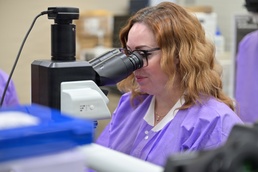
For Lily Urbina, a medical laboratory technician in the Department of Pathology and Laboratory Services’ Microbiology section, that perspective has shaped 35 years of laboratory work.
“If a sample comes through our department, usually it is an indication that the patient is not doing well,” Urbina said. “Whether it is a sample from a neonate or geriatric patient, as a professional I want to ensure the patient is receiving treatment as quickly as possible.”
Urbina has worked in numerous military hospitals and treatment facilities throughout her career. She joined Darnall in 2016, first working in the ancillary laboratory before moving to microbiology.
“I enjoy working in microbiology and feel that it is the most interesting section to work in,” she said. “There is always something new to encounter and learn from.”
That curiosity is paired with an unwavering attention to detail.
When a specimen reaches microbiology, technicians verify that it is properly labeled, ordered, and collected, even after it has been screened by the processing section. If something doesn't look right, they contact the provider for additional information.
Those details matter.
A specimen that isn't collected or preserved correctly can potentially produce inaccurate results, delay treatment, and waste valuable resources.
“Getting it right for me is prioritizing patient care,” Urbina said. “Is this sample salvageable without compromising our protocol or the integrity of the sample/test? Can we complete testing within our turn-around time so that there is no delay in patient care?”
For Lt. Col. Richard Thomas, chief of the Department of Pathology and Laboratory Services, a specimen isn't simply a specimen.
“I don't look at samples or specimens in terms of having a story,” Thomas said. “To me, each specimen is a life. It's a patient. It's that patient's future.”
The patient may never meet the laboratory professionals processing their specimen, but the information they produce can help guide the care that patient receives.
Behind the scenes, that means an almost obsessive attention to accuracy, Thomas said.
“We probably spend more time ensuring our work and the instruments we use to do it are functioning as perfectly as possible than we do actually performing the lab testing.”
That commitment was put to the test during a recent College of American Pathologists inspection involving a 12-person inspection team.
Across Darnall’s three CAP sites, 12 disciplines, and 29 checklists, the laboratory demonstrated a high level of performance across more than 3,000 standards, with no major findings.
For laboratory manager Lt. Col. Amanda Luschinski, the results weren't simply a reflection of preparation for an inspection.
“What stood out to me most was the consistency and preparation demonstrated across the entire team,” Luschinski said. “The inspection didn't create excellence; it revealed the excellence that was already there.”
The visiting inspectors even discussed taking some of Darnall’s practices and procedures back to their own laboratory, Thomas said.
The result, he said, belongs to the people doing the work every day.
“The techs are the stars of the show,” Thomas said. “They make the entire shop work, not me. Our performance on this inspection was maybe 10% my efforts, at best. It's the team that won this fight.”
For Urbina, that teamwork is especially important in microbiology, where identifying potentially harmful pathogens can directly affect a patient's care.
“We certainly don't want anything missed and will without hesitation ask for a ‘second set of eyes’ if necessary,” she said. “It brings me great pride to know we are saving lives.”
That same mindset extends beyond the laboratory walls.
“I would hope that patients know that we are not just working hard behind the scenes,” Urbina said. “We are also working with due diligence to ensure quality results are being reported.”
Luschinski said maintaining that level of performance requires discipline, accountability, teamwork, and a willingness to keep improving.
The CAP inspection may be something worth celebrating, but she said the bigger accomplishment is the team behind it.
“This was truly a team-of-teams accomplishment,” Luschinski said. “Every section, every shift, and every individual contributed to this success.”
That teamwork ultimately comes back to the same place: the patient.
“Every sample has a story, and every story represents someone who deserves our very best,” Luschinski said.
For the laboratory team, that means the work happening behind the scenes matters long after a sample leaves the patient's hands. Every check, test, and verification is another step toward giving a provider the information needed to care for that patient.
Thomas put it this way:
“Your blood (or skin biopsy, or whatever it is that's been collected) is going to disappear into a room full of tools no one anywhere else in the building understands, to undergo testing no one outside the lab knows how to do, using methods so rigorously controlled they annoy everyone not involved in the process.”
Then comes the information a provider needs.
“And the end result of that will be the information your doctor needs to give you the best treatment they can,” Thomas said.