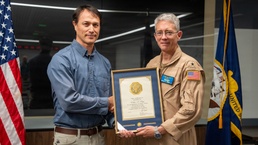
For Walter King, a 40-year career at the Naval Air Warfare Center Weapons Division is a professional milestone and a lifelong commitment to national defense. King, a systems engineer for Visionary Engineering for Combat Technology and Rapid-Response group, has spent four decades ensuring that our warfighter holds the decisive edge.
King’s deep roots in the high desert began in elementary school when his family relocated to the Ridgecrest area. Growing up near the Naval Air Weapons Station, King saw his career take flight in 1985 during his senior year at Burroughs High School, when a recruiter helped him land a student trainee spot in Michelson Lab.
"It was a vertically integrated group of engineers, technicians, and draftsmen working together to build projects," King said. "Seeing how those different disciplines came together made me realize I wanted to become an electrical engineer."
That spark carried him to California State University, Fresno to earn his engineering degree. Graduating straight into a full-time role with the F/A-18 software development team, King was soon writing tactical flight software for weapons and mission computers.
Early in his career, King made a leap of faith that would redefine his professional outlook. With his wife’s blessing, he volunteered for a year-long assignment at Patuxent River, Maryland, supporting the intense first year of flight testing for the F/A-18E/F Super Hornet.
That move across the country proved to be a career-changing experience, teaching him to embrace unexpected opportunities and never be too quick to say "no."
"That experience of stepping out of my comfort zone is why I encourage younger workforce members to say yes to variety," King said. "You never know where those new challenges will lead."
He brought that energized perspective back to China Lake, testing and integrating systems for the Super Hornet and EA-18G Growler platforms at the Advanced Weapons Lab and VX-31.
He later served as test and evaluation lead for the Advanced Anti-Radiation Guided Missile program and led the Advanced Medium Range Air-to-Air Missile Hardware-in-the-Loop upgrade before transitioning to target software development for the VECTR team.
Throughout these career milestones, King's proudest moments stemmed from keeping the end-user's safety and environment a priority. He believes that understanding how the fleet functions in its operational environment is vital to delivering new capabilities. This user-centric mindset proved true during a major F/A-18 design review, when he spotted a cockpit safety hazard that was missed by the primary contractor team.
"I understood how the aircrew would actually use the system, and I recognized a significant safety problem," King said. "We got it changed. It's better to prevent an accident than to analyze how one happened after the fact."
Off duty, King is a volunteer at his local Foursquare church. He enjoys woodworking and camping. But his ultimate labor of love is the home he spent seven years building from the ground up.
"It was a grueling challenge, but I got it done," he said. "It's about having a holistic life."
Four decades after first stepping into Michelson Lab as a high school student, King's career has come full circle. While technology has evolved from the pre-internet era to cutting-edge targeting systems, his driving motivation remains unchanged.
Reflecting on his 40-year legacy, King said public service is ultimately about being part of something larger than oneself. "Being part of a team working to defend and safeguard our country - and knowing you made a difference for the warfighter - is the ultimate reward."