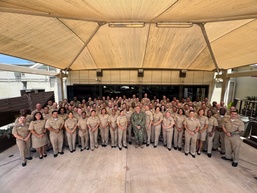
MCAS MIRAMAR, Calif. – More than 110 Medical Service Corps healthcare administrators, clinicians, scientists and military leaders from across Southern California gathered at the Marine Corps Air Station Miramar Officers’ Club Aug. 7, for the 2026 Southern California Medical Service Corps Officers’ Association Leadership Symposium, focused on strengthening leadership, professional development and readiness across Navy Medicine.
Held during the same week the Navy Medical Service Corps commemorated its 79th birthday, the symposium provided an opportunity to honor nearly eight decades of service while looking toward the future of the Corps and the leaders who will carry its mission forward.
Centered on the theme “Forged Through Adversity: Developing Resilient Leaders for the Force,” the symposium connected leadership development with the operational and strategic challenges facing Navy Medicine and the Fleet.
“This symposium is about more than professional development,” said Lt. Amy Bodea, president of the Southern California Medical Service Corps Officers’ Association and head of the operations management and security department at Naval Medical Center San Diego (NMCSD). “It is about strengthening our Corps, learning across specialties, and developing resilient leaders prepared to meet the evolving needs of Navy Medicine and the Fleet.”
Cmdr. Temitope Ayeni, director for administration at NMCSD, followed with opening remarks challenging attendees to look beyond their individual specialties and learn from the diverse expertise represented across the Medical Service Corps. He encouraged leaders to broaden their perspectives and carry those lessons back to the teams they lead.
That focus on developing adaptable leaders set the stage for Rear Adm. Matthew Case, acting surgeon general of the Navy and director of the Medical Service Corps, who provided a forward-looking discussion on the direction of Navy Medicine and the role of its people in generating readiness.
Case outlined Navy Medicine’s lines of effort, emphasizing force and medical readiness, quality and patient safety, talent management, and designing the future medical force. His message focused on ensuring Navy Medicine has the people, capabilities and organizational structure necessary to deliver ready medical forces to the Fleet while preparing for the demands of future operations.
For the Medical Service Corps, Case placed particular emphasis on talent management and the deliberate development of officers across its clinical, scientific and administrative specialties. His discussion highlighted the importance of developing, retaining and positioning talent to meet operational requirements while building the leaders Navy Medicine will need for the future.
Case also discussed the evolving organizational structure of the Bureau of Medicine and Surgery and how Navy Medicine is positioning the enterprise to better support readiness. His remarks connected enterprise-level transformation with the responsibility of individual leaders to develop their people, understand the mission and remain adaptable as operational requirements evolve.
The session concluded with a question-and-answer period, giving attendees an opportunity to engage directly with the acting surgeon general on career, leadership and organizational issues affecting the Corps.
“Today’s speakers challenged us to think strategically, lead courageously, and prepare the next generation of Medical Service Corps officers,” Bodea said. “The conversations we have here should extend beyond this symposium and into how we lead our teams, develop our people, and contribute to the mission every day.”
Building on Case’s focus on readiness and preparing for future challenges, two retired three-star flag officers broadened the discussion to the strategic environment in which Navy Medicine operates.
Vice Adm. Charles W. Martoglio, U.S. Navy (Ret.), whose nearly four decades of service included command at sea and senior strategic leadership assignments, examined confrontation, conflict and uncertainty in today’s global security environment and the demands those conditions place on military leaders. His presentation reinforced the importance of strategic thinking and adaptability as operational conditions evolve.
Vice Adm. Robert Thomas, U.S. Navy (Ret.), former commander of U.S. 7th Fleet, provided an Indo-Pacific perspective on alliances and the contributions of the Medical Service Corps to alliance maintenance. His discussion highlighted the role of medical diplomacy, healthcare logistics and partnerships in strengthening relationships with allies and supporting deterrence throughout the region.
Together, the strategic presentations helped attendees bridge the gap between tactical responsibilities and strategic-level thinking, connecting their daily roles as Medical Service Corps officers to the broader environment in which the Navy operates. That connection resonated particularly with junior officers in attendance.
“As a junior officer, having the opportunity to hear from strategic leaders of this caliber is incredibly impactful,” said Lt. Amanda Rabbitt, NMCSD medical logistics assistant department head and SoCal MSCOA vice president. “This symposium truly highlighted the significance of our roles, showing us how every specialty, from logistics to clinical care, directly contributes to keeping our warfighters ready.”
The afternoon continued with an address from Capt. J. J. Bailey, commander of NMCSD, who challenged attendees to consider how character, perspective and perseverance shape resilient leadership. Drawing on lessons about overcoming adversity and learning from the people and experiences that shape us, Bailey emphasized that effective leadership is built not only through professional achievement, but through the values and lessons leaders carry into the way they serve and develop others. He shared personal insights on resilient leadership, and the responsibility leaders carry in developing strong teams.
The symposium concluded with a Navy Personnel Command discussion focused on career development, led by Medical Service Corps detailers Cmdr. Crystal Massey and Lt. Cmdr. Jarret White. Their session provided officers with insight into career progression, leadership opportunities and milestone decisions, reinforcing the importance of deliberate career planning and talent management to the long-term readiness of the Corps.
Closing remarks from Ayeni brought the day’s discussions full circle before attendees transitioned to the evening’s celebration of the 79th Medical Service Corps Birthday Ball.
From Case’s enterprise-level priorities to strategic competition, resilient leadership and career development, the symposium reinforced a common message: readiness begins with people. Developing leaders who can adapt, collaborate across specialties and understand how their work contributes to the operational mission remains essential to preparing Navy Medicine for the challenges ahead.
As Bodea emphasized, that responsibility extends beyond a single event. “Together, we are developing resilient leaders for the force.”
NMCSD employs more than 5,600 active-duty military personnel, civilians, and contractors in southern California to deliver exceptional care afloat and ashore.