ANDERSEN AIR FORCE BASE, Guam — Valiant Shield 26 brought together air, surface, and subsurface assets in coordinated live strikes, hypersonic launches and a vast live, virtual and constructive training environment. Grounded in the U.S. Pacific Command framework of peace through strength, the biennial exercise demonstrated credible combat power and the agility of the Joint Force.
However, at Andersen Air Force Base in Guam, and more than 1,500 miles away at Misawa Air Base in Japan, more subtle yet pioneering experiments unfolded. Researchers were not measuring weapons effects or kill chains. They were measuring something far more difficult to quantify: the cognitive workload of the human beings making split-second, life-or-death decisions.
Industry partner researcher Dr. Sandro Scielzo brought experimental biometric technology into the Installation Control Center at Andersen to measure and assess the mental workload of battle managers. His colleague, Anthony Nguyen, performed similar experiments with F-35 pilots in Misawa.
Nguyen also examined human-machine teaming dynamics as pilots trained with uncrewed aircraft. While Scielzo had conducted similar research before, those experiments occurred in controlled environments. "Valiant Shield is the first time this technology has been brought into a secured classified environment," Scielzo said. "It's the first time we're actually using these separate technologies in such an exercise, it has never been done before."
According to Scielzo, the most basic question the experiments set out to answer was deceptively simple: Is capturing cognitive workload even feasible in such a dynamic environment?
The experiments relied on a wrist-worn biometric device—comparable in concept to a commercial fitness tracker—built on an open-architecture "Emotbit" platform packed with sensors. These sensors captured biometric markers such as electrodermal activity (skin conductivity), heart rate variability, an accelerometer to detect movement, ambient temperature, and skin temperature.
Industry previously built a cognitive workload classifier using machine learning—a model validated and published using data from pilots.
Bringing this validated pilot model into the battle management space required adaptation. One significant engineering hurdle was the classified environment itself: all wireless and Bluetooth capability had to be removed from the original biometric device, with a custom-made chip added so the device could be hard-wired.
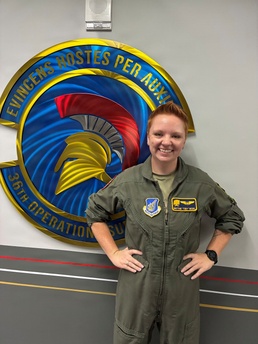
Capt. Brittnie Wedel, 36th Operations Support Squadron, served as a Regional Air Defense Command Director and Command and Control exercise director during Valiant Shield 26. She wore the biometric device while leading her team during “vuls” or vulnerability periods where multi-domain attacks on Guam were simulated.
"I value the cognitive monitoring, because I know the human element that goes into battle management processes is going to be different for everybody,” said Wedel. “There's great value in it."
She said stressors included people around her talking about non-mission-essential topics, followed by the demand of quickly analyzing incoming threats and determining her responsible actions. Her most stressful moment came on a day with multiple inbound missiles and crises, when she had to rapidly translate tactical information to the operational level for a senior-ranking decision-maker who was, in turn, looking to her for recommendations.
This warfighter perspective aligns with what Scielzo observed in his real-time monitoring: workload spikes occurred when battle managers were multitasking—talking while moving items on screen, with others speaking to them simultaneously.
A central application of the research is enhancing tactical debriefs. Typically, 15 to 30 minutes after an exercise ends, key stakeholders meet to dissect what happened—why a "leaker" got through, why multiple shooters targeted the same threat, why something wasn't deconflicted. By mapping a key operator’s workload onto the event timeline, cognitive load data adds a powerful new dimension.
Scielzo annotated workload spikes in Simplified, Planning, Execution, Analysis, and Reconstruction, known as SPEAR. SPEAR is a multi-domain distributed debrief and adjudication asset that ingests and visualizes high-fidelity data streams—including sensor tracks, command and control messages, effects chains, and mission outcomes. During tactical debriefs, SPEAR colleagues displayed this information on large screens, allowing stakeholders to correlate moments when an individual was saturated with moments when performance dropped.
Being able to visualize biometric insights alongside tactical events during debriefs enables actionable insight, such as the need to distribute a specific saturated role among multiple warfighters. According to Scielzo, these objective, validated measures remove individual bias.
“Some warfighters are stoic and insist they are fine even at their breaking point, while others amplify minor stress,” said Scielzo. Objective measurement also enables continuous monitoring, capturing workload every second—something impossible to achieve by repeatedly interrupting a warfighter doing their job.
Scielzo shared that one of his most striking findings was that as the scenarios grew harder during the exercise, self-reported workload rose—but so did team cohesion and performance.
"That is an indicator of high efficiency teams, teams that can adapt, bond together better, and learn how to solve problems meaningfully together," said Scielzo.
Both Scielzo and Wedel see the research pointing toward a future of human–machine teaming. "I think that it will cue us into what machine-to-machine type technology we can bring to the table to lower that cognitive load,” said Wedel. “So, the more we can have computers do things, the more brain space it frees up for us to make decisions that a computer cannot make.”
At Misawa Air Base, the Collaborative Combat Aircraft Academy from industry partners contributed computer-generated, semi-autonomous “wingmen" that enabled the first ever virtual collaborative combat aircraft integration in a live exercise. Nguyen leveraged the opportunity to collect cognitive data that will be used to further the U.S. Air Force 53rd Wing, Air Combat Command Experimental Operations Unit’s research into human-machine team relationships.
“The fact that we could do it is a win,” Nguyen said.
According to U.S. Air Force Maj. Daniel Pesich, Experimental Operations Unit collaborative combat aircraft detachment officer in charge, the future of airpower is a partnership between skilled warfighters and the technology that empowers them. “By advancing human-machine teaming, we are increasing our power projection while building a more resilient, capable, and lethal joint force,” Pesich said in a statement.
Maj. Robert Pluneda, chief of safety for the 35th Fighter Wing and an aerospace physiologist at Misawa AB, said the true significance of the research is that it proves cognitive workload can be objectively measured during realistic operational missions, rather than just in a laboratory.
“We've traditionally relied on observations and post-mission debriefs to understand how aircrew perform under stress,” Pluneda said. He noted that warfighters often fail to recognize when their workload peaks or cannot accurately recall every demanding moment. Providing objective physiological data offers a vital new perspective to better understand the human element of combat operations.
From Pluneda’s perspective, effective human-machine teaming is the center of future military operations. As AI and autonomous systems take on repetitive tasks and process massive amounts of data, the human operator is freed to focus on judgment and tactical priorities. “Understanding cognitive workload helps identify where automation provides the greatest benefit while ensuring the warfighter remains firmly in command of critical decisions,” said Pluneda.
He emphasized that a primary benefit of this data is providing individualized feedback to help warfighters identify specific mission phases where their cognitive workload consistently spikes. “The goal is not to evaluate or grade someone differently, but to provide actionable insight that helps improve decision-making, build confidence, and increase mission readiness,” said Pluneda. “Over time, this feedback can be used to tailor training, enhance crew coordination, and refine system design.”
The cognitive load experiments were a formal USPACOM J7 Pacific Multi Domain Training and Experimentation Capability deliverable, integrated as part of the broader live, virtual, and constructive training environment. Scielzo recognized PMTEC for including the research in Valiant Shield 26.
"I think it takes guts because not everybody is receptive to bringing that kind of innovation in that LVC space,” said Scielzo. “But it's paying off, because we've proven that we can collect meaningful data."
According to PMTEC Program Manager Dr. Andre Stridiron, transforming cognitive load from an invisible vulnerability into a quantifiable, actionable metric, lays the groundwork for smarter command structures, accelerated decision cycles, and truly integrated human-machine teams.