Vertical construction is hard to miss. Say, a brand-new hospital or a four-story facility to house a national security and defense agency. Drive by and you are likely to notice as construction progresses skyward. But what about horizontal construction – that is, construction happening low to the ground and stretching several miles?
It might not be as noticeable to passersby or be as visually impressive, but horizontal construction on a mega scale is no less of an engineering feat than its vertical counterpart. That is especially true when the construction reduces flood risk for 30,000 people and more than $10 billion in economic infrastructure, which is exactly what the Kansas Citys Levees project accomplished.
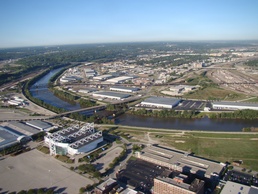
Completed in near-record time and under budget by the Kansas City District, U.S. Army Corps of Engineers, the project expanded floodwalls, improved levees and replaced or repaired aging pump stations along 17 miles of the Kansas River, protecting economically vital areas of downtown Kansas City, Kansas, and Kansas City, Missouri – hence the name "Kansas Citys."
The project was a partnership with the Kaw Valley Drainage District, the Unified Government of Wyandotte County and Kansas City, Kansas and the City of Kansas City, Missouri. Despite facing unprecedented challenges along the way, the team was able to deliver on one of USACE’s core missions: protecting life and property by reducing flood risk.
It all started in the summer of 1993
The confluence of the Kansas and Missouri rivers in downtown Kansas City, Kansas and Kansas City, Missouri, is home to a national manufacturing, distribution, transportation and warehousing hub. Additionally, the area is home to one of the country’s largest railyards and roughly 30,000 residents. Reducing flood risk to the area has been in the works for more than 30 years, stemming from the Flood of 1993.
“[1993] is the record flood on the lower Missouri River,” said Jud Kneuvean, readiness and contingency operations chief for the Kansas City District. “Basically, it filled the Missouri River Valley from bluff to bluff – from just above Rulo, Nebraska, all the way to the mouth [in St. Louis.]”
Sometimes called “Kansas City’s cruel summer,” flooding began in July of that year after months of extensive rainfall across the region. By July 27, 1993, the Missouri River crested and came within mere inches of overtopping the levees protecting downtown Kansas City. USACE initiated reviews after the Flood of 1993, which resulted in investment to improve flood mitigation infrastructure along the Missouri River.
“During the 1993 flood, river levels in the Kansas City metro area were higher than expected,” said Jared Mewmaw, Kansas Citys Levees programmatic technical lead. “This led to an effort to reanalyze the Kansas and Missouri rivers’ flood flows and levee systems.”
According to Mewmaw, efforts to improve infrastructure resiliency on the Missouri River have been completed, but the Kansas River remained vulnerable to flooding. After receiving funds to study flooding on the Kansas River in 2018, the Kansas City District began the final leg of a decades-long project to reduce flooding on the two rivers. However, it wouldn’t be long before the project encountered challenges few could have predicted – a perfect storm, one might say.
Congress sets an aggressive schedule
After receiving authorization and $529 million in funding from Congress, the Kansas City District was charged with planning, designing and constructing the Kansas Citys Levees mega project in just seven years. Considering the scope of the project, this timeline was ambitious to say the least
“The project consisted of raising approximately 90,000 feet of levees and floodwalls, modifying gatewells, utility relocations and numerous railroad closure structures,” said Brian Cates, quality assurance representative for the project.
The ambitious timeline wasn’t the only thing setting the project apart from most others. According to Scott Mensing, Kansas City District chief of engineering and former Kansas Citys Levees program manager, the mega project was fully federally funded, which allowed it to move at an accelerated speed.
“Full federal funding allowed us to gain interest and excitement from industry, achieve an aggressive schedule and build an amazing team of subject matter experts from around the nation,” he said.
One of those team members was Mewmaw, who worked on the project since it began in 2018. He acknowledges the project’s accelerated timeline required the team to do things a little differently.
“The seven-year schedule from design start to construction completion was extremely aggressive,” said Mewmaw. “To ensure enough time for construction, the design team used risk-informed design to accelerate design milestones and performed extensive community outreach.”
By engaging with the local community early and often, the team was able to gain support for the project while also reducing the number of real estate acquisitions needed, which ultimately helped the project stay on schedule. But staying on schedule was not the only positive result from the extensive community outreach by the team.
“The community recognizes the importance and need for the project,” said Mensing. “Including them early, actively listening to them and engaging with them has allowed the team to connect with those we’re serving.”
The Missouri River floods, again
The Kansas Citys Levees design team was already facing an uphill battle with the accelerated schedule mandated by Congress. Less than a year into the project, the longest-duration flood of record on the lower Missouri River began.
According to Kneuvean, the 2019 flood was a culmination of a bomb cyclone in the upper Missouri River basin, which resulted in large amounts of snowpack melting and caused flooding throughout the basin. But before USACE could begin recovery efforts due to flooding from the upper basin, heavy rainfall in the lower Missouri River basin began, further straining levees and floodwalls.
“We started off with what they call a bomb cyclone. Then we saw widespread localized heavy rainfall, which led to a very long duration flood event in the lower basin,” said Kneuvean. “From March when we declared a flood event until it ended in December, it was 279 days.”
The Kansas City District was all-hands-on-deck for flood response and recovery efforts throughout the region, including members of the Kansas Citys Levees design team. However, despite being stretched thin during 2019, the design team did the unthinkable and was able to stay on schedule.
“The 2019 flood occurred during the design phase of the project. This put additional strain on the design team when they were called upon to support flood response actions,” said Mewmaw. “The design team demonstrated flexibility and dedication to the project by fully supporting flood response duties and maintaining project design milestones.”
The world shuts down and prices rise
Facing an exceptionally tight schedule and coming off response and recovery efforts following another historic flood event, the Kansas Citys Levees project team was confident they were setting sail into calmer seas. Then, almost exactly one year from the start of the 2019 floods, the entire world shut down, practically overnight.
The COVID-19 pandemic forced many people – including the Kansas Citys Levees project team – to stay home. Despite the uncertainty, fear and the rapidly changing rules regarding the disease, the design team did not waver and continued to showcase their ability to adapt at a moment’s notice.
“During the design phase, the team transitioned to work from home,” said Mewmaw. “They adjusted on the fly and still maintained the aggressive design schedule.”
Two years into the pandemic, the world faced another threat: inflation. Hitting a record high in 2022, inflation drove the price of labor and materials to an unprecedented level. According to the Bureau of Labor Statistics, a combination of supply chain disruptions, consumer demand and government spending caused prices to shoot through the roof.
Although all sectors of the economy were affected, the construction industry was hit especially hard. Adding insult to injury, the bulk of construction on the Kansas Citys Levees project began in 2020 – the same year the pandemic began.
Even the strongest teams could have buckled under the pressure of a global pandemic and the increasing costs of labor and materials. But the Kansas Citys Levees team proved once again they were not the average team. According to Mensing, they prioritized fostering a culture of empathy, trust and respect, which helped them succeed, despite facing multiple challenges.
“Our team fully committed to a mission and vision to safely deliver this project faster than anyone could imagine,” he said. “The team has truly developed a team culture based upon a drive to deliver a complex project to the community.”
Railroad coordination takes center stage
As the Kansas Citys Levees project moved into the home stretch, one more challenge stood in front of the team. However, unlike the 2019 flood and the pandemic, the team knew this one was coming from the beginning. During a flood event, resilient structures are needed to prevent the railroad tracks from flooding. To construct railroad stoplogs – temporary structures put into place in the event of a flood – the railroads would have to temporarily cease operations. Without stoplogs, the nation’s entire economy would be affected during a flood event.
“[The project] is located in the heart of one of the largest railroad terminals in the country. Each year, the region experiences more than 100,000 trains that move more than 600 million gross tons of freight,” said Mensing. “Movement of freight and people through Kansas City is critical to our national economy.”
Any business owner knows a disruption in operations cuts directly into the bottom line. For the nation’s railroads, one of the most critical forms of transportation in the country, disruptions to service are not a welcome prospect. Knowing they’d have to temporarily shut down railroad operations to construct the stoplogs, not developing a positive working relationship with the railroad companies was not an option for the Kansas Citys Levees team.
“The project required the completion of 12 railroad closure structures. Each closure required outages of tracks during construction operations,” said Mewmaw. “Coordination started during the design phase and continued through the construction phase.”
Once again, the Kansas Citys Levees team’s culture of trust and respect proved to be their most important asset, successfully helping them complete all contracted railroad closures without causing significant disruptions to railroad operations or project construction. According to Cates, the railroad coordination was one of the project’s biggest challenges, but also one of its biggest successes.
Mensing agreed, saying, “the team recognized the project would impact railroad operations and we prioritized communication and collaboration with each railroad company. All 12 closure structures were approved by the railroads in 18 months or less. Construction of the initial eight occurred over the last two years, and each completed closure was fully tested in less than 12 hours – an engineering and construction feat never accomplished before and one that may never be accomplished again.”
Setting the example for USACE
As the nation’s engineers, USACE is no stranger to working under challenging circumstances. The resiliency and adaptability of the Kansas Citys Levees mega project team is perhaps one of the best examples of persevering even under the most extreme challenges. In the end, the team was able to achieve the unthinkable – they completed the project under budget and on schedule.
“USACE met its commitments to reduce flood risk – under budget – on a project that dealt with a significant flood, a pandemic and during a significant inflationary period,” said Mewmaw. “I am proud the team overcame [these challenges] and still maintained an aggressive schedule.”
Nothing worth having comes easy, as the saying goes. For those who worked on the project, there is a common theme for which they credit the project’s success: teamwork.
“This was a huge project that took lots of patience and coordination,” said Cates. “I am most proud of the relationships and the teamwork it took to complete.”
The Kansas Citys Levees mega project will be declared officially complete in September 2026, significantly reducing flood risk to 30,000 residents and more than $10 billion of infrastructure. Having the opportunity to deliver such a vital project for the local community was a once-in-a-lifetime opportunity for the more than 300 people who had a role in the project, from planning and design through construction.
“The people on our team are simply the best of the best. This attitude energized each team member and allowed us to create a culture where people wanted to work on this project,” said Mensing. “They wanted to be part of the excitement; they wanted the challenges; they wanted to test their professional capabilities. It has been a career highlight of mine to be one of the leaders for this team.”